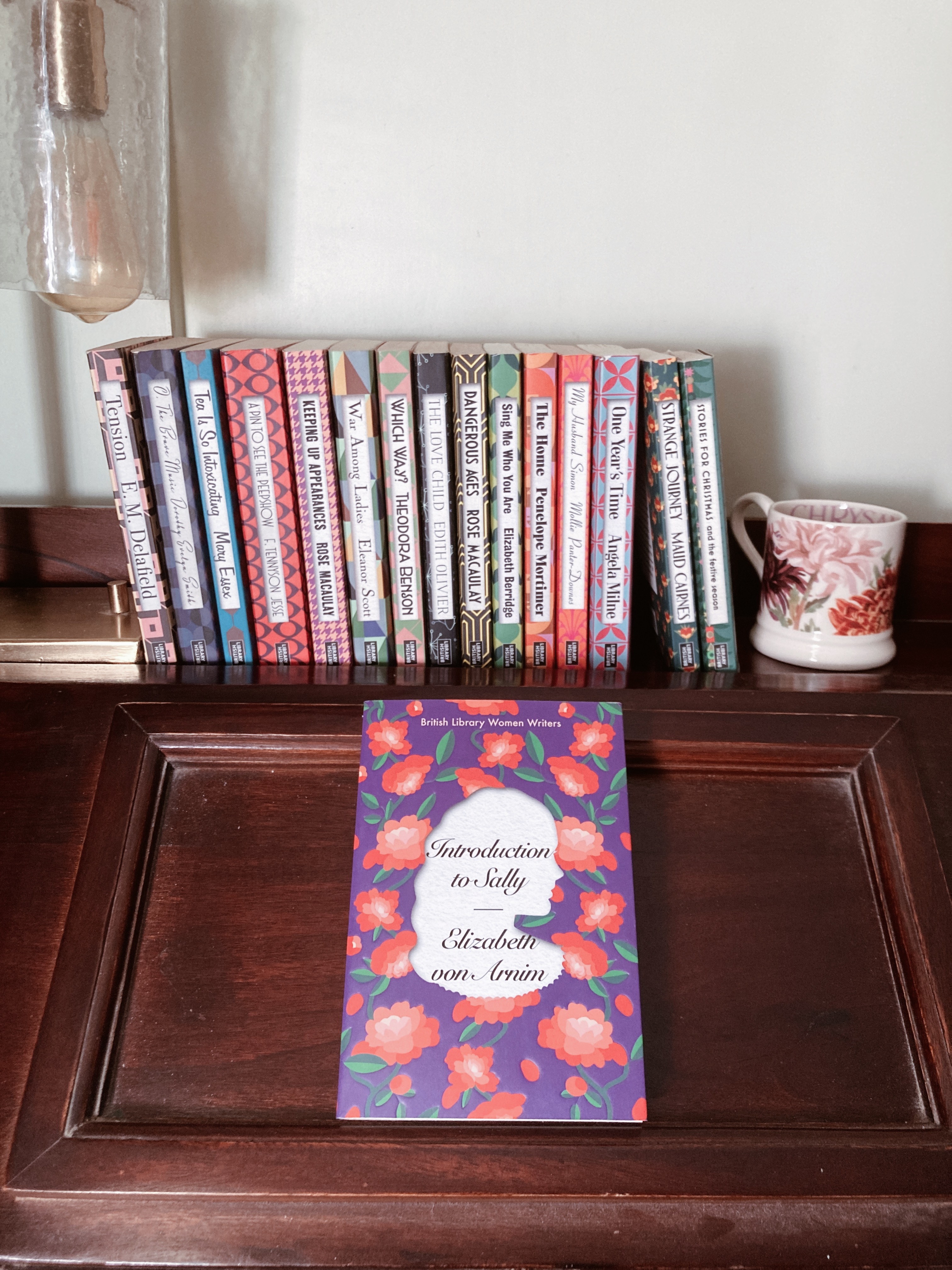
‘Introduction to Sally’ by Elizabeth von Arnim is a novel about a young woman of exceptional beauty, who causes a flurry of excitement wherever she goes due to her great beauty. Rather than act as a boon, Sally’s exceptional looks bring her the wrong type of attention and this is a matter of concern to the people related to her. First her Father, then her protective husband and then people who get to know her well are flustered by the amount of attention Sally unwittingly receives.
Sally has one great disability, at least in the eyes of the upper middle class and upper classes of society that she finds herself in and that is her inability to enunciate well, particularly her ‘h’s’ at the beginning of words, in fact she is encouraged to quickly lose the Cockney accent that she has used and known her entire life.
This is an extremely funny novel and von Arnim’s knack for bringing out the ridiculous in social situations makes it a novel that will strike you at every twist and turn of plot, but at the same time – to me at least – it is a heartbreakingly painful novel. A novel where one has to look upon the plight of a naive innocent young girl who is worshipped superficially and is trained to behave in ways that completely delete her past. It highlights how much beauty is revered in society. There’s also a very uncomfortable line drawn between the social classes – there are the Pinners of the world spouting their Cockney accent and leading honest hardworking lives, the Dukes and Duchesses of the world with nothing much to do with their time except look towards the next form of personal amusement, and then the Lukes of the world – living in genteel poverty yet steeped in snobbery, studying at Cambridge and trying to win respect and admiration through their accomplishments.
This is an interesting novel with Sally at the centre of it all. In fact an ‘Introduction to Sally’ will have you feeling, and experiencing many things in the short course of meeting her. The crux of the matter is : is there anyone in her life who can see past Sally’s good looks and love her for who she is?
Sally’s parents are hardworking people living in London and running a grocery shop. Mrs Pinner however, attracts a lot of attention due to her good looks and has to be protected by her husband from all and sundry. The couple have a much awaited daughter after many years and the Pinners decide to call her Salvatia – a baby who brings about salvation of their souls and spirits – but Mr Pinner is not to know then, the trouble Salvatia or Sally as she is called, will bring him.
When Sally is a young girl, Mrs Pinner passes away and now it is Sally’s turn to command everyone’s attention due to her startling good looks. Mr Pinner retires to a quiet sleepy village in the vicinity of Cambridge and hopes that no one will discover Sally there. He doesn’t take into account however, the number of undergraduate students at Cambridge who pass through the sleepy village and call on his grocery store.
One day, a young brilliant undergraduate called Luke Jocelyn chances upon Mr Pinner’s shop and is awestruck with the vision of Sally. He forgets all his academic ambitions, his bright future, his family, his purpose – all he knows is that he is beguiled with Sally and must have her for his own. When he proposes to marry his daughter, Mr Pinner’s initial anger regarding Jocelyn’s attentions, turns to joy and within the fortnight, Sally is married off to Luke Jocelyn.
During the blissful first moments of the honeymoon in Cornwall, Luke’s initial state of besottedness succumbs to horror as he realises that much is to be desired regarding Sally’s delivery of speech. Dropping of h’s at the beginning of words, terms and phrases, in fact her Cockney dialect and all the little niggling details of her lack of education and total oblivion regarding social niceties – makes him realise that he has to introduce Sally to his Mother – a snobbish woman who is very proud of her son and his accomplishments and is very aware of her position in society.
When Mother meets Sally for the first time she makes gentrifying Sally a full-time project and Sally, much to her dismay is temporarily abandoned by her husband who goes back to Cambridge. There’s nothing left for Sally to do but abandon ship, leading to disastrous, weird and wonderful consequences. The book is quite a joy-ride of action and activity but through it all one can’t help feel sorry for Sally, who wants nothing more than two rooms to live in, a number of babies to take care of and ‘usband’ to come home to her at the end of the day.
Is it a satire against society? Perhaps it is. And one can only wonder about a society so chained to a love for superficial ideals, wealth and an awareness of class differences. We need more people who have Sally’s heart, her love for home, her innocence and the freshness of her voice. A thoroughly thought-provoking novel shedding light on the social sensibilities of the 1920’s.
’Introduction to Sally’ was sent to me as a review copy but as always, all thoughts about the novel are my own.


 Bag Full Of Books