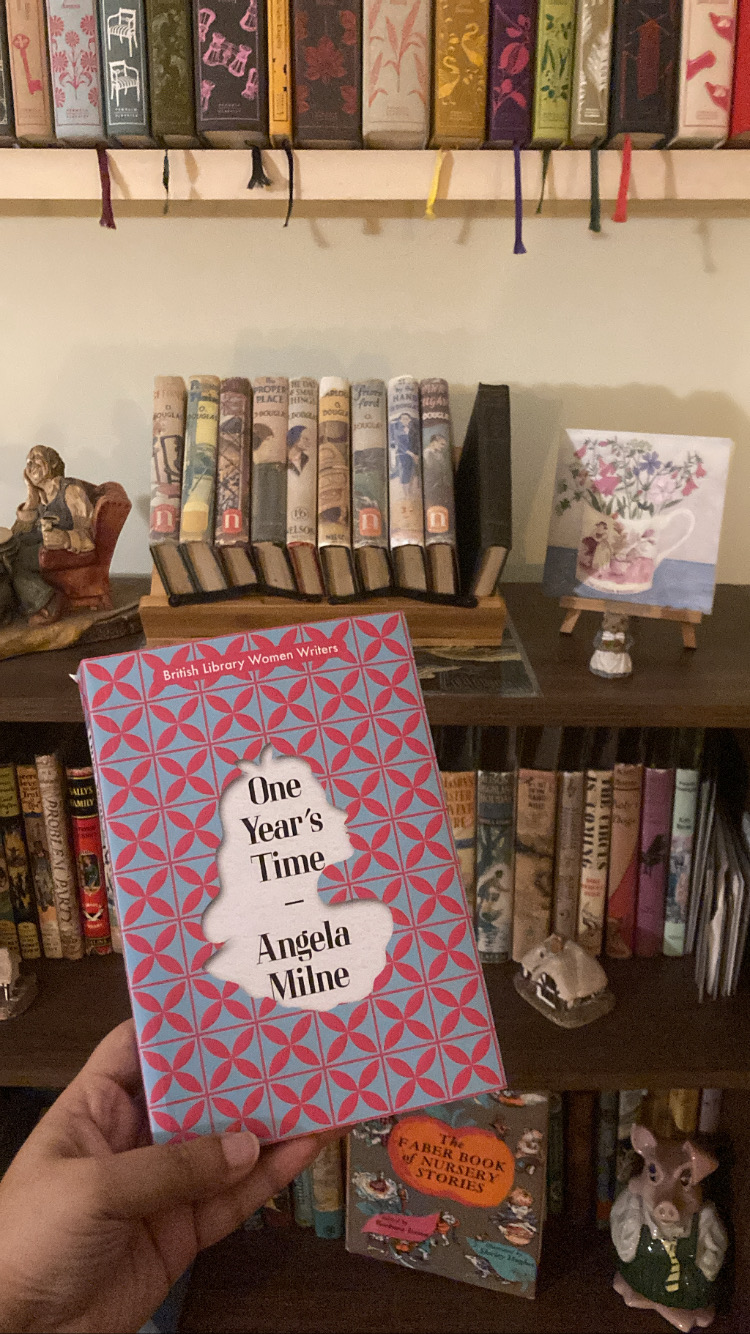
‘One Year’s Time’ is a novel that examines the complex relationship between a young man and woman over the course of one year, in the years leading up to the Second World War.
It is a relationship which starts off as a sexual encounter, after a chance meeting at a London party and the nature of the bond between Liza and Walter, remains one of a physical relationship, with the understanding between both individuals that it will not mature into anything as permanent as marriage. Though both parties proclaim that they want the same thing – that is not to be tied down by marriage, Liza resists from expressing her hope that one day Walter will propose marriage to her. In essence, Liza is never fully able to be herself around Walter, in fear that revealing her true emotions might push him away. On the surface, Walter appears to be kind and considerate, but his control over Liza, his emotional manipulation of her behaviour, her decisions and actions in life is evident to the reader. It is a novel of mental struggle, hope and disappointment, pent-up emotions, waiting and watching. But when an entire year passes by and Liza is still waiting, it is left to her to express her true emotions and hope that she means enough to the man she loves.
The novel starts with Liza poised on the threshold of a New Year, pondering about the future and wondering what the unfolding year will bring. The novel is dissected into four parts – based on the four seasons. The four seasons describe the passage of a year in time and also the variously unfolding seasons in Liza and Walter’s relationship. That of first love and the fresh excitement of being with someone new in the Spring. Then the experience of living together in summer in a small cottage in the depths of the English countryside. Then the autumn spent apart – with Liza having a seaside holiday with her Aunt and Walter travelling and spending time alone in France. Finally there is winter, when the novel reaches a climax and the relationship situation between Liza and Walter comes to a head.
Liza is young, relatively independent, has her own private income which she supplements by working as a secretary in a small office in London. She has no really close family in London. There is a cursory mention of a Father in India and a brother in Vancouver, but they play no part in the novel. Liza’s nearest kin in England, are her Aunt Vi and family living in rural Wiltshire.
After their initial meeting at the dawn of a new year, the young couple bound by their mutual physical attraction for one another spend a lot of time in each other’s company. Some nights are spent in Walter’s bachelor digs in Hampstead, but mostly it is Liza’s Chelsea flat, in which they spend the Spring. Their love is new and fresh and the two of them go to parties, eat at restaurants and drive out to the countryside on idyllic day trips. One weekend, the couple visit a remote English village and spend the night at a local pub. Liza slips on a wedding band, for the sake of respectability but on the trip, she discovers to her mortification, that Walter had spent a previous Christmas, in the company of a married woman, staying at the same pub. Rather than express her grievances and woes, throughout the course of the novel, we witness Liza keeping her real thoughts to herself. Whenever we see her expressing any kind of true feeling and emotion, Walter reacts with annoyance, and that deters Liza from speaking out.
At the beginning of summer, Walter has the sudden urge to leave his work at the law office and spend time working on his novel. He persuades Liza to leave her job, lease her flat to friends and they decide to rent a small cottage in the countryside, where nobody will know about them. The cottage comes with a sleepy village, where the shopkeepers call Liza, Mrs Latimer. Their only neighbours are another couple, Kate and her husband – the latter works in London and comes down to the country on weekends. Kate soon guesses from closely observing the couple that Liza and Walter aren’t really married. Kate and Walter form a close bond with one another, continually teasing and bickering with one another. Liza continually doubts whether Walter and Kate’s feelings runs deeper than it appears, although she never finds any incriminating evidence against Walter. Liza slaves over the housework during the hot summer whilst Walter procrastinates with writing his novel.
After a summer of lassitude on Walter’s part, he rather selfishly decides to escape to the Continent in the Autumn, to France, while Kate holidays elsewhere in Europe. Liza, decides to return to her Aunt Vi and spend time with the family on their summer holidays at the seaside. To pass the time and escape from her loneliness she painstakingly reads Walter’s copy of ‘Titus Andronicus’. Liza, frequently picks up books from Walter’s bookshelves – sometimes a detective novel, sometimes Shakespeare, once Walter’s Everyman copy of Shakespeare’s Historical Plays, Songs and Sonnets. Perhaps she reads these books to educate herself, to escape the boredom of everyday life, or to impress Walter. However, it’s interesting to notice that Liza tries so hard to mould herself according to Walter’s likes and dislikes.
After their Autumn holidays apart, Liza fully expects to move back to London, live with Walter and take up a job again. There is also that desperate hope and expectation that Walter will propose marriage to her. However, Walter unexpectedly takes up a job at boys’ boarding school and is rarely available. Liza deeply upset tries to salvage the remnants of her past life – her secretarial job and her old apartment in Chelsea. One can feel the sense of comfort she gains in reestablishing herself in her old digs and working with the same group of people. This feeling of sameness helps to alleviate the gnawing sense of unhappiness that Walter’s neglect is causing her. Whilst visiting her Aunt Vi, she meets a young man called David, who is the nephew of one of her Aunt’s neighbours. With David, Liza finds a sense of peace and happiness. David is everything that Walter is not. He is solid, respectful, considerate, kind and reliable. Although Walter is charming and handsome, he is largely absorbed in his own world and prioritises his own thoughts and desires.
Liza after the course of one tumultuous year, finds herself at a crossroads, where she must be strong and make a decision about what she wants in life. If she speaks out and tells Walter what she thinks of him, or what she desires from their relationship, she faces the risk of losing him.
Set at the fag end of the 1930’s with the prospect of war looming on the horizon, ‘One Year’s Time’ is quite a modern novel and quite openly addresses the subject of sexual relationships outside the context of marriage and its social acceptability at the time. That this kind of relationship was not the norm is evident from the many instances in the novel that Liza tries to keep up the appearance of being a married woman. Whilst the reader knows that Liza wishes wholeheartedly to become a married woman, the same cannot be said for Walter. Whilst Walter’s ideas might represent that of a set of people of London society of the time, one can’t help but feel that these ideas fit in well with Walter’s own, rather selfish needs and wants. Though aware of Liza’s inner unspoken expectations and feelings, he chooses to ignore them, instead convincing her that they both want a casual relationship without marriage. The veneer of charm that Walter always exudes, at least when he is getting his own way, blinds Liza to the nature of their rather one-sided relationship. Deeply penetrating, intimate, soul searching and sometimes heartbreaking, Angela Milne explores in great detail the intricate workings of a woman’s mind when she is grappling for a sense of emotional security.
What makes the book even more than an emotional lesson in relationship dynamics is the beautiful writing, the descriptions of home and the workplace, the warm sense of comfort in spending Christmas with family in an English village and most of all – the sense of peace and contentment in a relationship where both individuals are loving and giving.
‘One Year’s Time’ is certainly a special book to read for those people who appreciate the complex landscape of human relationships. Written by the niece of AA Milne, one can’t help wishing, this compelling writer had written more. Thanks to Simon David Thomas for uncovering this gem.
Many thanks to the British Library Publishing Group for the gift of this review copy. As always, all thoughts are my very own.


 Bag Full Of Books