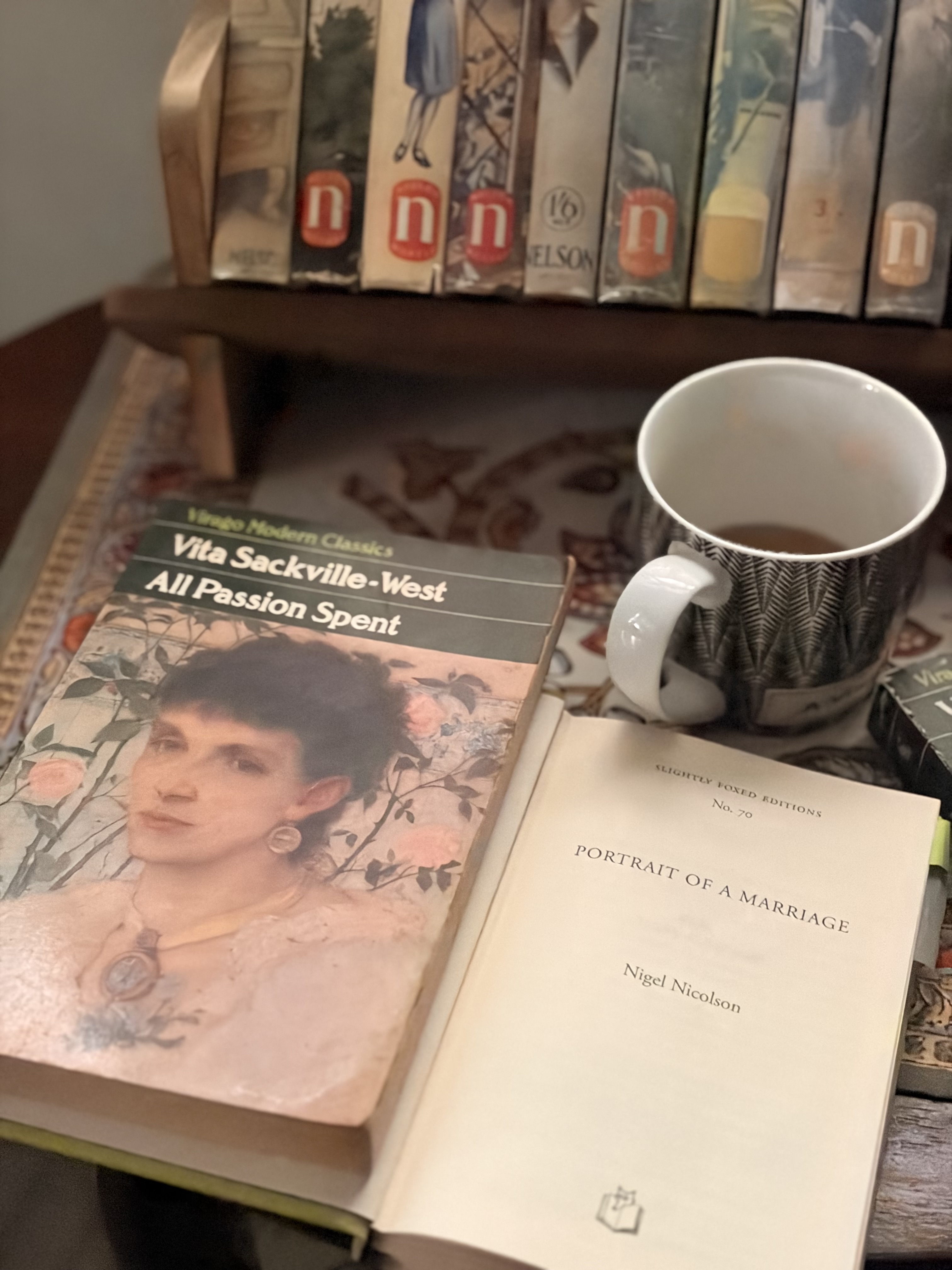
Published: 1973
Author: Nigel Nicolson
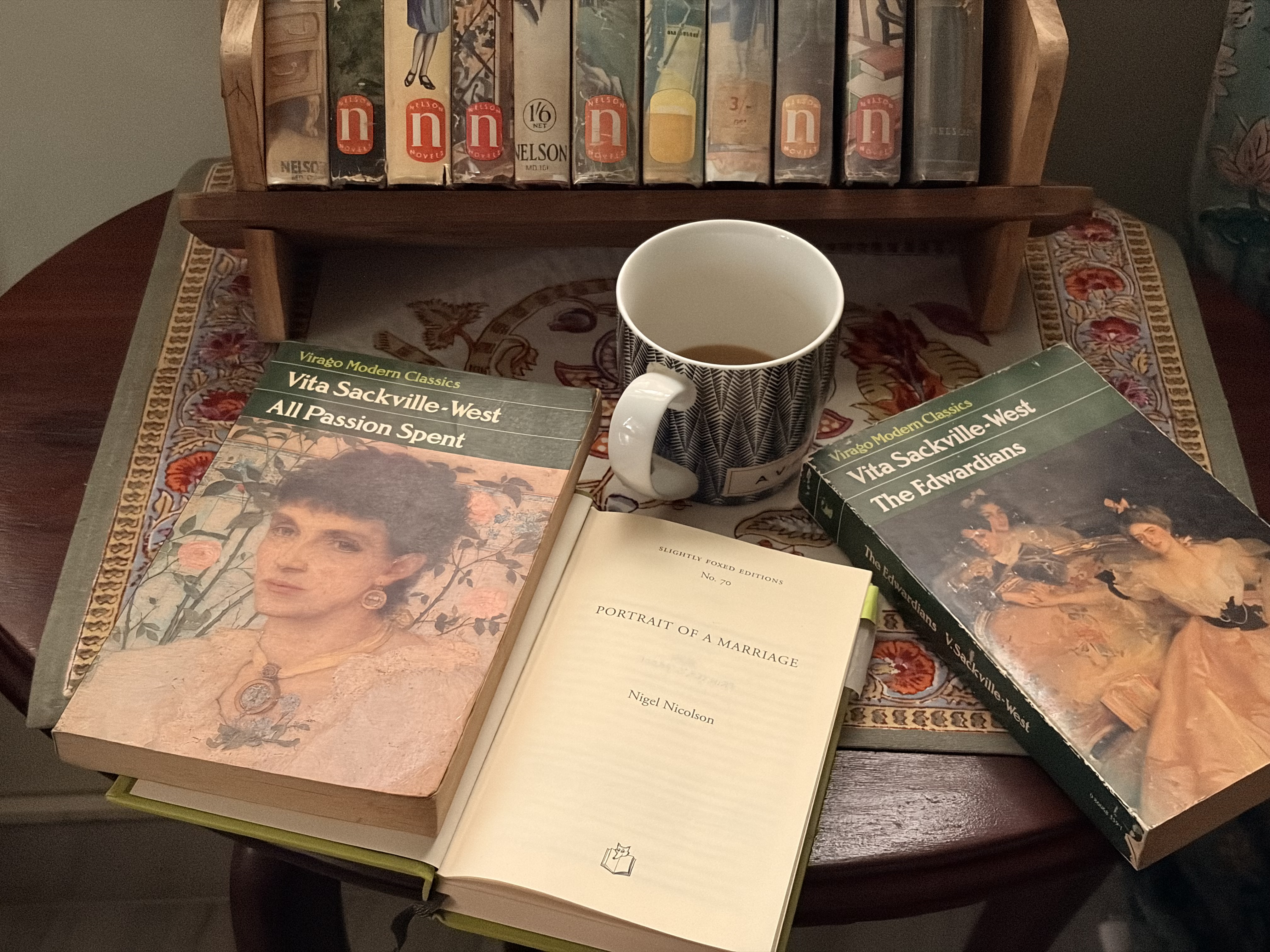
Publisher: Slightly Foxed Ltd
Genre: Memoir/Biography
Subjects: Vita Sackville-West (V S-W), Harold Nicolson (writer and diplomat), Violet Keppel, Rosamund Grosvener
Setting: Knole (large country house with 52 staircases, spread over 1000 acres)
Format: confessions of Vita about her love affair with Violet Keppel. Vita’s diaries are interspersed with notes and commentary from her son, Nigel Nicolson
Summary: ‘Portrait of a Marriage’ is a description of several years in the married life of Vita Sackville-West and Harold Nicolson, part autobiography by Vita, part biography by the couple’s younger son Nigel Nicolson. In particular the book describes those critical years when the couple’s marriage teetered on a dangerous precipice. It was threatened by Vita’s affair with Violet Keppel, climaxing when Vita and Violet eloped to France, only to be retrieved by their respective spouses. What shines through in the book is the extraordinary bond that Vita and Harold shared with one another. Their marriage is an example of a relationship that didn’t follow conventional norms, but still worked for them in private, defying societal judgement, gossip and speculation.
On reading the memoir in its entirety, a few lines from the foreword have struck me the most and stayed with me. Penned by Nigel Nicolson, they read thus:
“It is the story of two people who married for love and whose love deepened with every passing year, although each was constantly and by mutual consent unfaithful to the other. Both loved people of their own sex, but not exclusively. Their marriage not only survived infidelity, sexual incompatibility and long absences, but became stronger and finer as a result. Each came to give the other full liberty without enquiry or reproach. Honour was rooted in dishonour. Their marriage succeeded because each found permanent and undiluted happiness only in the company of the other.”
Part One of the book is Vita Sackville-West’s personal diary from 1920, which attempts to recount details of her affair with Violet Keppel and purge her mind of the love she had for this woman. One can gauge a certain level of frustration that the author had, how she could not reconcile herself to loving someone of her own sex. She speaks of a ‘Dr Jekyll and Mr Hyde personality’.
“That is the whole crux of the matter, and I see now that my whole curse has been a duality with which I was too weak and too self-indulgent to struggle.”
This personal narrative of Vita’s is interspersed with notes from her son, Nigel Nicolson. Though the later pages of the book do mention Vita’s relationship with Virginia Woolf, this book does focus more wholly on Vita’s relationship with Violet Keppel, the single incident, which threatened to break Vita’s marriage with Harold. After this, the couple developed an understanding that remained unbroken, despite their subsequent infidelities.
Part One and Part Two have a number of streams of narrative : Vita’s parental family history and her childhood at Knole and the inheritance dispute of the family estate of Knole. Vita first met Violet at the age of 12. They went to school together in London but their relationship didn’t develop romantically till much later, when Harold and Vita were married for five years in 1918.
Part One and Part Two of Vita’s narrative serve as the prelude to the development of the affair. It details Vita’s family history, her Gramdfather’s love and special attention to her at Knole, the 1000 acre family estate, over which there was a very public legal battle upon Vita’s grandfather’s death. Vita’s parents won the estate and it was Vita’s home till she married the diplomat, Harold Nicolson in 1913. The couple set up their own home at Long Barn in a tumbledown cottage, two miles from Knole, which was extensively restored and extended by Sir Edward Lutyens, companion to Vita’s mother.
It was in the Spring of 1918, that Vita and Violet’s affair started at Long Barn. Harold was away on foreign diplomatic work. Vita and Harold were separated a lot due to Harold’s work and they missed each other tremendously, writing to one another frequently to fill the void between them. Violet was to be engaged to Denys Trefusis the following year – a relationship that was one-sided, in that Violet was obsessed, devoted to Vita and wanted to leave everything and live with her.
The climax was reached in 1920, when Vita and Violet planned to elope together to Amien in France. Rather ironically, on Valentine’s Day of 1920, Harold and Denys both flew to Amiens in a two seater aeroplane, piloted by Denys Trefusis. They then retrieved their respective spouses and took them back separately to Paris.
In the next year or so, although Vita and Violet met and went away together, their relationship dwindled. Violet returned to Denys. Vita went on to have relationships with different people but she always came back to her anchor and support, her constant companion to the end – Harold Nicolson. I feel their son, Nigel summarises the pattern of their relationship perfectly in the lines –
If their marriage is seen as a harbour, their love affairs were mere ports of call. It was to the harbour that each returned; it was there that both were based.
If one steps back from all the dates, the isolated events, the places, the people, the history that reside in the book, one person in particular shines through the narrative – Vita Sackville-West. One can’t help but believe that she must have been a tremendous personality. To have the capacity to love so many people, to have so many people love her so fervently, to have a constant, steadfast companion like Harold Nicolson to the last – now that highlights no ordinary individual.
Many Thanks to the Folks at Slightly Foxed for sending me a review copy. All thoughts and opinions are my own.