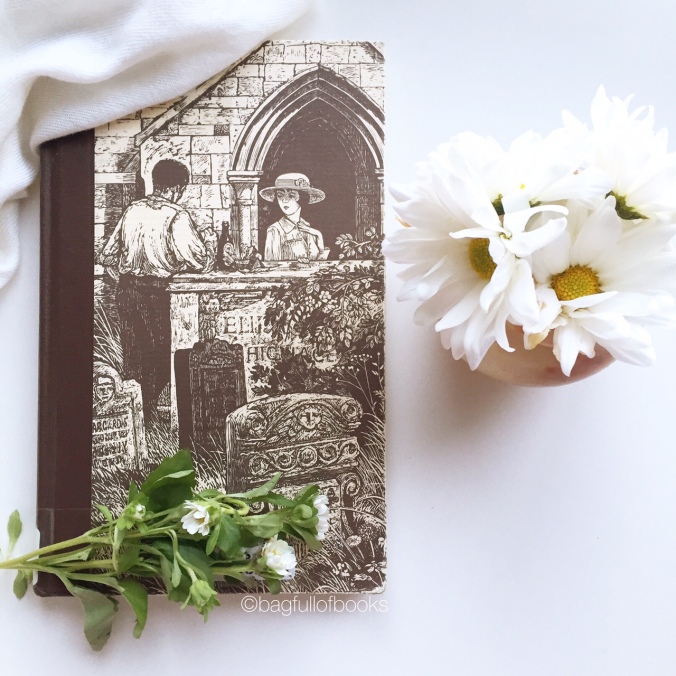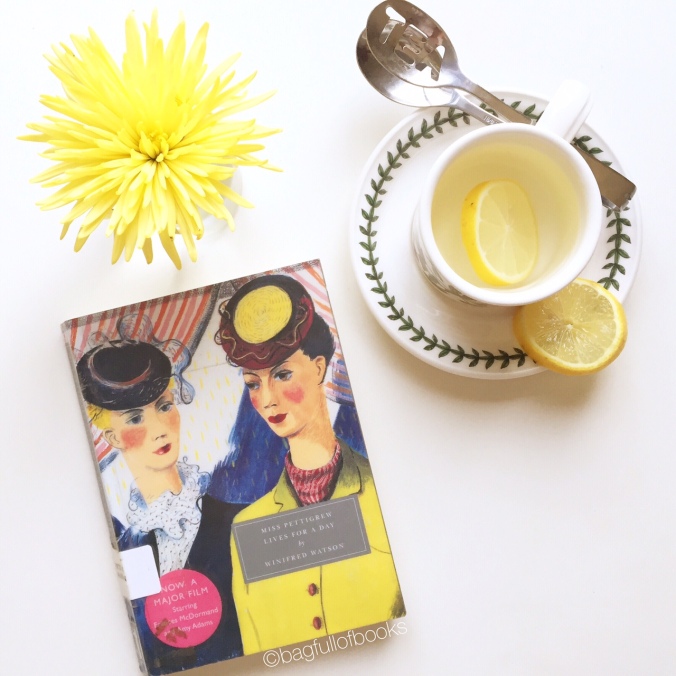
January, 2016 Wrap Up

IMG_1200

Here is a round up of book related favourites for the month of January, 2016. For a glimpse into December, 2015’s Bookish Favourites please see here.

1. Books

 I read a total of seven books in January. I read mostly from the modern classics genre and successfully ticked off two titles from my list of 12 New Authors I Would Like to Read in 2016 (that made me feel very good!). I enjoyed all these books so much, especially The Diary of A Provincial Lady and A Month in the Country.

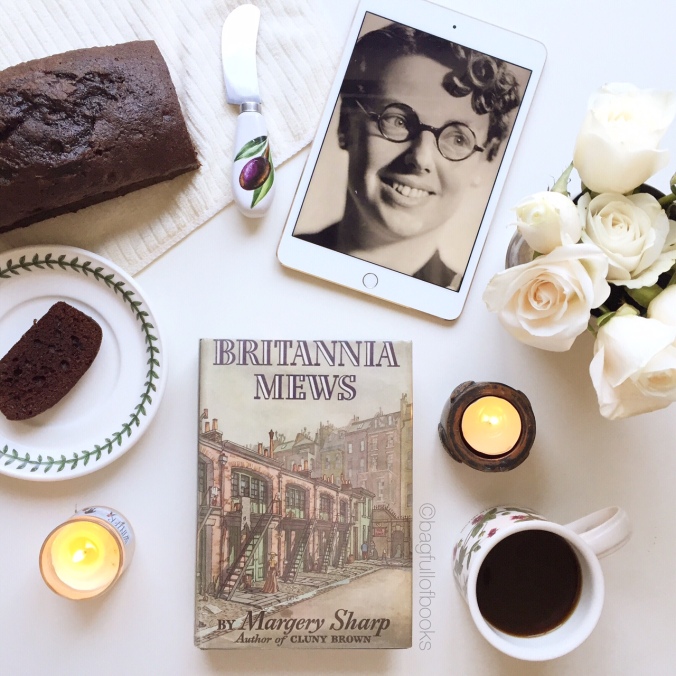
1) Britannia Mews by Margery Sharp

I realised I posted about this book in December but didn’t manage to finish it till January. I reviewed this book as part of Margery Sharp Day hosted by Jane from the lovely blog Beyond Eden Rock.

Britannia Mews is a book that describes the life and times of the central character of Adelaide Culver, a child of privileged circumstances, living in one of the row of houses along London’s Albion Place. Adjacent to Albion Place, stands Britannia Mews, once a stable, housing the horses used by the genteel folk living in Albion Place but now reduced to a slum at the turn of the nineteenth century.

Set in the late nineteenth century, Victorian London is portrayed at the intersection of where the rich meet the poor.  Adelaide Culver, marries her struggling art tutor and thereby goes to live in the slums of Britannia Mews. This is the story of what happens to a girl who has bravely broken away from the family shelter into a life of domestic strife and hardship. I enjoyed Margery Sharp’s excellent writing, descriptive and laced with subtle wit and wisdom. For a full review please see here.

IMG_0829

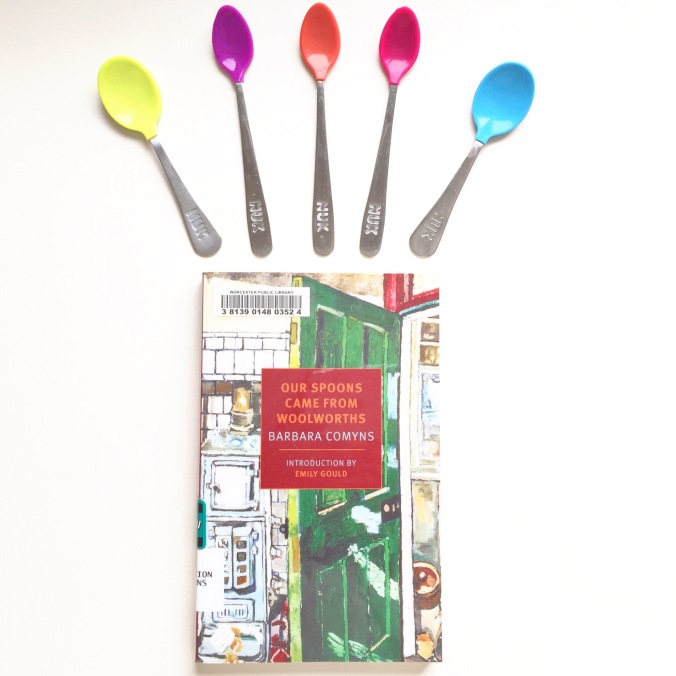
2) Our Spoons Came From Woolworths by Barbara Comyns

Our Spoons Came from Woolworths is the story of twenty-one year old Sophia, during the time when she was married to Charles Fairclough. The story is in its entirety, a first person narrative and tells of the harrowing poverty, the ups and downs of the young couple, in a time during which Charles refuses to take any financial responsibility for his household, using his need to practice his art as an excuse to shirk his duties. This was an exceptional book! For a full review please see here.

IMG_0153

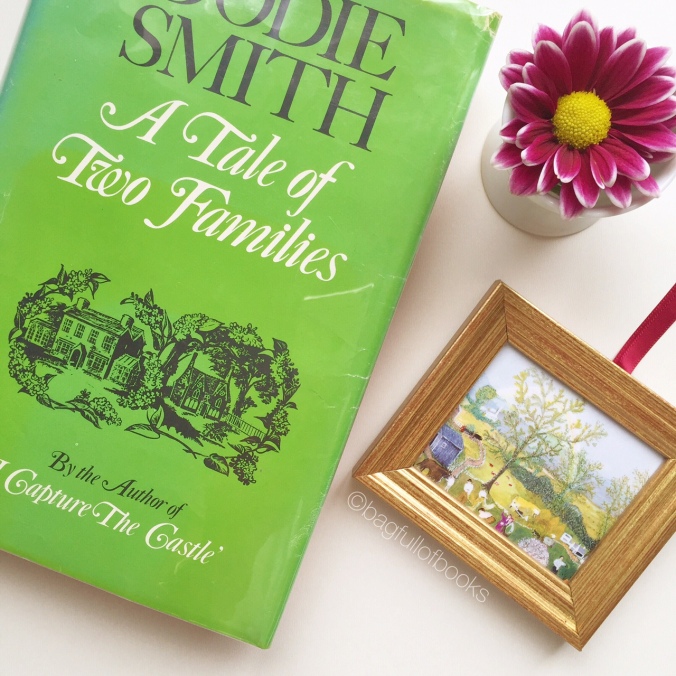
3) A Tale of Two Families by Dodie Smith

A Tale of Two Families by Dodie Smith is the story of the relationship between two families: those of May and June, two sisters, who marry two brothers, George and Robert. When May and George decide to relocate to the countryside for a few years, on a landed estate with a small cottage, it seems the most natural thing for June and Robert to leave their father’s house and set up home in the cottage on May and George’s leased estate. Robert, a skilled but lesser known writer plans on writing his magnum opus in the idyllic surrounds of the cottage. June is happy to be carefree and close to her sister. Robert and George’s father, Baggy, comes to stay with George’s family. May and June’s delightful mother, Fran, decides to stay with her two daughters for a while. The children in the family come upto the property on weekends, from London or the boarding schools they go to and a good time is had by all in the family. Then the close proximity leads to unforeseen events…

For a full review please see here.

IMG_0426

4) A Month in the Country by JL Carr

A Month in the Country by JL Carr is the story of war veteran Tom Birkin and the unforgettable summer he spends in the country, uncovering and restoring a medieval wall mural inside an old country church. It is a journey of discovery for Tom Birkin, both in regards to his work and rediscovery of self after the trauma and ravages of his war experiences. This was a charming, poignant novel. I felt that the narrative was a little uneven, which made it a bit of a slower read, but on the whole the story was so wonderful and evocative that I can’t help but look back upon it, with starlight in my eyes.

IMG_0611

5) The Diary of a Provincial Lady by EM Delafield

This was my favourite book this month and it really made laugh. The diary entries are so self deprecatory and certain incidents so cringe-worthy, they make great reading.

6) Mystery at Saint-Hilaire by Priscilla Hagon (Mabel Esther Allan)

I don’t remember how I came upon this book or the author but I was lucky enough to find a copy at my library. I’m glad I did. It read exactly like a grown-up Enid Blyton book so if you are a Blyton fan, this is a book for you.

7) Miss Pettigrew Lives for a Day by Winifred Watson

This was another favourite book this month. Quite funny, with several quotable, witty, one liners, this tells of a day in the life of staid, middle aged Miss Pettigrew. It is a day of astonishing unexpected events that transform Miss Pettigrew’s mind and outlook on life for ever.

IMG_0831


2. Movies and Audiobooks

The only movie I watched this month was the BBC adaptation of Tess of the D’Urbervilles (screenplay by David Nicholls) and it was soooo good! It really made me want to pick up the book and read it. I listened to the BBC full cast adaptation of Agatha Christie’s The Sittaford Mystery. I do enjoy these full cast dramatizations: it almost feels like going to the theatre.

3. Miscellany

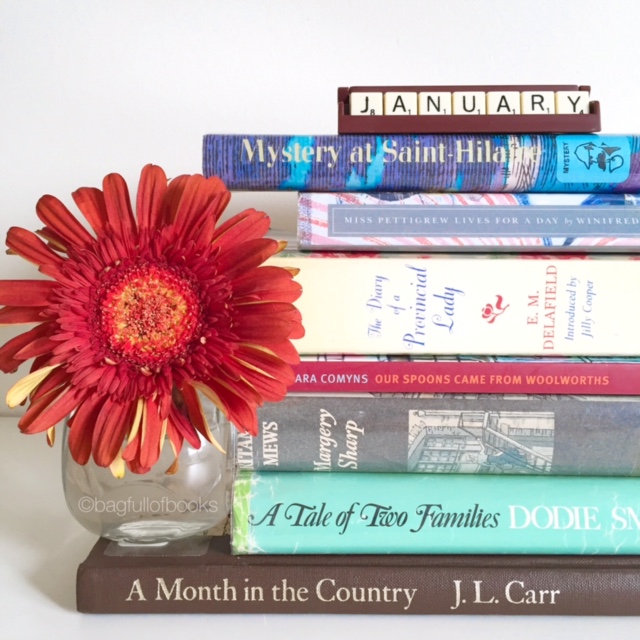
I bought so many books this month. Most of them were bought with Christmas money or were gifts to myself to revive my dwindling library. I hope to enjoy and read them over the next couple of years. Here is a picture of the books!

I hope you all had a great month of reading. I have several library books to get through in February which I am excited to share. Do have a great month!

Britannia Mews by Margery Sharp

IMG_0829

This review is written in celebration of Margery Sharp’s birthday on January 25th, 2016. I would like to thank Jane from Beyond Eden Rock for encouraging us to celebrate the life and works of a wonderful author, most of whose works remain difficult to find.

‘Britannia Mews’ is a book that describes the life and times of the central character of Adelaide Culver, a child of privileged circumstances, living in one of the row of houses along London’s Albion Place. Adjacent to Albion Place, stands Britannia Mews, once a stable, housing the horses used by the genteel folk living in Albion Place but now reduced to a slum at the turn of the nineteenth century.

Adelaide falls in love with her art teacher and aspiring artist, Henry Lambert and throwing all caution to the winds, elopes with him, to live a life of severely reduced circumstances and drudgery in a small house in Britannia Mews. In the beginning, Adelaide is happy with her new found independence, the novelty of keeping her tiny house spick and span and the belief that Henry will make a name for himself in art circles.  Slowly, however, she is resigned to the fact that Henry is a drunk, with no ambition in life and has married her for no reason other than a desire to get by on Adelaide’s annual income.

When Henry Lambert falls to his death from the steps of his Mews house due to accidental circumstances, Adelaide believes she has been released from the prison that she has created for herself in Britannia Mews. She longs to go back to her parental house in the countryside. However, a devious neighbor has witnessed the slight push that Adelaide gave her husband that accidentally led to his death. This results in blackmail: the neighbour forces Adelaide to pay her ten shillings a week and compels her to stay on in the Mews.

Then as time passes on and Adelaide’s life seems very bleak she discovers real love in the most unexpected way. The strength of this attachment (with a man named Gilbert) gives her the strength to forsake everything and everyone else in her life. Adelaide and Gilbert create a Puppet Theatre in the Mew’s stables and this eventually leads to the upliftment of Britannia Mews and several of its residents. The birth of the famous Puppet Theatre leads to the gentrification of Britannia Mews. Adelaide’s success leads to great empowerment; Adelaide is envisioned as a strong inspiring woman by subsequent generations. The Theatre brings employment to several individuals and much needed entertainment to innumerable people, especially during the dark, dreary times of the Second World War. The story is brought full circle when Adelaide inspires her niece to forsake her life of comfort and luxury in rural suburbia and live a life of artistic endeavor and adventure in running the Puppet Theatre in Britannia Mews.

Set in the late nineteenth century and leading into the years spanning the Second World War, Britannia Mews is a story spanning several generations and several important world events.

The attitudes and affectations of Victorian London are very much at variance with those of subsequent times and these are highlighted in the different characters of the story.

The book focuses on the intersection of where the rich meet the poor, the difference in living conditions of the two factions, the snobbery of the upper class, the raucousness of the underbelly of London society and the dissolution of these classes with the onset of the Second World War.

Women are portrayed in strong, influential roles. They marry to please themselves, not to gratify society. Convention is severely flouted in the book ‘Britannia Mews’.

It is an astonishing novel on many levels and depicts a slice of English history that is multifaceted and rich in detail. I’ve enjoyed reading a Margery Sharp novel that is a little different from the other books I have read, but quite, quite lovely!

Martha, Eric and George by Margery Sharp

IMG_0194

This review is written in celebration of Margery Sharp’s birthday on January 25th, 2016. I would like to thank Jane from Beyond Eden Rock for encouraging us to celebrate the life and works of a wonderful author, most of whose works remain difficult to find.

‘Martha, Eric and George’ is the third book in the Martha trilogy written by Margery Sharp. For reviews of the first two book in the series, please see here and here.

If ‘The Eye of Love’ was a lively entree into this delightful trilogy, ‘Martha in Paris’ was a deliciously light and entertaining prelude to the substantial finale of the drama- ‘Martha, Eric and George’, surrounding the central character of Martha.

The child Martha, her stolid personality, her large appetite, her obsession with drawing and sketching, even in the most trying circumstances amuses us in the book ‘The Eye of Love’.

In ‘Martha in Paris’ Martha due to her benefactor, Mr Joyce’s encouragement, accepts an opportunity to study art under a master-class artist in Paris. In Paris, she meets Eric, an English bank employee, and the two embark on a relationship of sorts, brought about under the most peculiar circumstances!

Martha’s plans to seriously continue her artistic studies are seriously thwarted, however, when she discovers that she is carrying Eric’s child. ‘Martha in Paris’, memorably concludes when Martha deposits her newborn son (unknown to Eric) on the doorstep of Eric’s Parisian apartment.

‘Martha, Eric and George’ starts when the baby is discovered by Madame Leclerc, the concierge of the apartment buildings that Eric and his mother reside in. In all her thirty years of being concierge at the building, this incident, perhaps, tops it all.

…she hadn’t meant to be defrauded of the most exciting incident in all her thirty years as concierge. There had once been a suicide on the Fifth, a burglary on the Third; in each case Madame Leclerc gave evidence, for so respectable a house it wasn’t bad, but neither episode could touch, for drama and human interest, the act of placing within the arms of a serious young man his illegitimate offspring.

Eric is astonished to discover that he is a father.

His single pertinent thought was still classic. “Oh God,” thought Eric Taylor,”why did this happen to me?”

Bewildered, Eric unburdens his offspring into his Mother’s arms, who is delighted to find that she is a grandmother.

Meanwhile, Martha escapes to England and starts practicing her art in earnest. In the next ten years she develops a reputation as a formidable artist. She does not think of her son during this time. Eric, is unable to track down Martha due to lack of a forwarding address. When an opportunity to exhibit her work in Paris arises, ten years later, she is  reminded that somewhere in Paris, she has a son.

There is a remarkable section in the book that describes the meeting of Martha, Eric and George in a Parisian coffee shop. One can only imagine the repercussions of such a meeting. One would imagine a mother to be visibly moved upon meeting her son, perhaps her heart might be softened upon seeing her offspring… one can never be sure, especially with Margery Sharp’s excellent storytelling.

Without giving too much away, I will leave it to you to find out what happens next…

Eric, Martha and George deals with several feminist issues: those of a woman or mother’s expected role in society. Indeed, it challenges those societal norms. We are encouraged to think sometimes, why should a man too, not be expected to play a nurturing role, outside that of merely supplying monetary sustenance to a child?

This is a clever book. One which kept me and keeps me thinking about it.

A Tale of Two Families by Dodie Smith


IMG_0426

  • Title: A Tale of Two Families
  • Author: Dodie Smith
  • Published: 1970
  • Location of the story: rural England

‘A Tale of Two Families’ by Dodie Smith is the story of the relationship between two families: those of May and June, two sisters, who marry two brothers, George and Robert. When May and George decide to relocate to the countryside for a few years, on a landed estate with a small cottage, it seems the most natural thing for June and Robert to leave their father’s house and set up home in the cottage on May and George’s leased estate. Robert, a skilled but lesser known writer plans on writing his magnum opus in the idyllic surrounds of the cottage. June is happy to be carefree and close to her sister. Robert and George’s father, Baggy, comes to stay with George’s family. May and June’s delightful mother, Fran, decides to stay with her two daughters for a while. The children in the family come upto the property on weekends, from London or the boarding schools they go to and a good time is had by all in the family. Then the close proximity leads to unforeseen events…

The reason for the move is in one way precipitated by May’s need to distance herself from George’s philandering ways in London. George, is a successful businessman in London. He commutes to his workplace by the train. The two sets of adults in the family along with Baggy, settle into a routine. George leaves early in the morning. May, ever the dutiful wife, gives him an early breakfast and he pops off to work on the train. May is busy with various household activities during the day. Robert, potters about the garden and keeps planning his novel in his attic study in the cottage. June is blissfully happy to be in the countryside, so near her sister and George. Quite disturbingly, we learn of June’s secret infatuation for George, a fact that she conceals quite well. George, returns home from work every evening laden with gifts for household members. The couples frequently dine together or George visits the cottage to watch television together in the evenings.

Baggy, the boys’ father feels a little isolated in his small wing of the house. Despite the fine food and company, he misses his home in London, which he had shared with Robert and June. Though May, spoils everyone with her beautifully cooked meals, she lacks the warmth that June had. Baggy also misses his old routine, nightly soaks in his bathtub with his granddaughter’s bath toys! This loneliness is somewhat abated when Fran, the girl’s mother comes to visit. Though Fran Graham is in her seventies she retains her youthfulness, both in spirit and in appearance. When she arrives at the country house by  a taxi, she is mistaken for a young girl by her grandchildren and Baggy.

‘Hello, here’s a taxi. Some girl appears to be arriving.’

Dickon, joining him said, ‘That’s no girl. That’s my grandmother.’

‘Fran does have a girlish figure,’said Prue, then raced after Dickon who was already on his way to the front door.

The family group is complete and a period of great contentment sets in. The lilac bushes on the estate are in full bloom. Nightingales can be heard in the dead of the night.

‘Heavens, how lucky we are,’ said June. ‘Lilac and a nightingale! And there’s a marvelous laburnum coming out near the cottage- and a may tree.’

‘”The lilac, the laburnum and the may”,’ said Robert.’I’m sure that’s a quotation…

They were back at the cottage now. Robert’s torch shone on a drift of cow parsley, left on the edge of the lawn.

‘”Where the cow parsley skirts the hawthorn hedge”,’said Fran.’And I do know who wrote that: Rossetti, the most loved poet of my girlhood.’

This idyllic period is disrupted when Fran’s sister, Aunt Mildred, or ‘Mildew’ as she is jokingly referred to, comes to stay. Aunt Mildred, creates a toxic environment within the household, owing to her childish ways and her overactive imagination which leads to events that have irrevocable consequences.

‘A Tale of Two Families’ arrested my attention till the last page. It had sublime, romantic moments filled with poetry and nature but it didn’t relapse into a completely cozy novel due to the great sexual tension, Dodie Smith developed in the novel.

It is a book I enjoyed reading and will, no doubt, re-read in the future. It is, to echo Dickens, a story about two families, in the best of times and worst of times.

Two poetry references in the book prompted the #poetrymatchart tag on Instagram. The first reference is to a poem by Charles Mackay, the second a poem by Dante Gabriel Rossetti.

I am inserting the posts below.


Introducing #bookmatchartwork – the pairing of a unifying theme in literature and art

Today I am posting about two things I am very passionate about- books and paintings. So by incorporating a hashtag #bookmatchartwork I will be trying to pair two otherwise unrelated creative bodies of work. This Instagram post befriends Peter Mayle with Van Gogh- in the beautiful location of sunny Provence.

Our Spoons Came From Woolworths by Barbara Comyns

IMG_0153

‘Our Spoons Came from Woolworths’ is the story of twenty-one year old Sophia, during the time when she was married to Charles Fairclough. The story is in its entirety, a first person narrative and tells of the harrowing poverty, the ups and downs of the young couple, in a time during which Charles refuses to take any financial responsibility for his household, using his need to practice his art as an excuse to shirk his duties.

The story commences when Sophia and Charles, two art students, meet on a train, are immediately drawn to one another and decide to marry even in the face of severe opposition from Charles’s family, who believe that domestic responsibilities and marriage will hamper Charles’s artistic progress. Charles’s mother Eva, practically falls upon Sophia and accuses her of trapping her son.

Eva said I was not capable of love, only lust, and it was all a trap to catch Charles.

They are married in less than ideal conditions, in a church ceremony, presided over by an impatient priest, a handful of less then enthusiastic friends and relatives and the bride wearing an ugly green wrap-over skirt that had a tendency to unwrap at the most inopportune moments.

They arrange to live in a small flat on Haverstock Hill in London. With the ten pounds that a spiritualist friend gives them for a wedding gift they buy  furniture and household essentials.

We had a proper tea-set from Waring and Gillow, and a lot of blue plates from Woolworths; our cooking things came from there, too. I had hoped they would give us a set of real silver teaspoons when we bought the wedding-ring but the jeweler we went to wouldn’t so our spoons came from Woolworths, too.

Sophia earns two pounds a week with which she pays the rent, food and other household expenses. Charles stays at home painting. He sometimes tries to get work at commercial studios but nothing turns up in the face of the Great Depression. He is not troubled by the fact that he does not in any way contribute to the family. Sophia states:

Charles was quite happy just painting away, and as long as I earned two pounds a week and there were a few cheques in the drawer he hadn’t a care in the world.

This happiness is broken when Sophia quite unexpectedly discovers that she is expecting a child. At first she thinks her sickness is a result of eating too many strawberries but a visit to the doctors dispels that idea.

There is a quite memorable passage describing Sophia’s vague ideas regarding birth control:

I had a kind of idea if you controlled your mind and said ‘I won’t have any babies’ very hard, they most likely wouldn’t come. I thought that was what was meant by birth-control, but by this time I knew that idea was quite wrong.

Sophia although eager to be a mother is weighed down with the knowledge that Charles is terribly against being a father because he does believes they will not fit in with the kind of life he want to lead.

As time goes on, the stash of wedding cheques kept in a drawer whittle down and the couple find themselves living from hand to mouth, always guessing where the next few pounds will come from, to pay of their substantial debts. The descriptions of the poverty that Comyns describes are at times quite harrowing. They are told in quite a light manner though so that the reader does not feel excessively weighed down.

Sophia’s loss of job before having the baby signals the downward spiral that the couple find it hard to recover from.

I found the book to be quite compelling reading. The descriptions of Sophia’s child delivery in the hospital were at times quite funny but also shocking. The book quite brilliantly reflects the period that it describes, the hard circumstances of the Depression and the plight of women.

The book is very much a story about women, for women. Even in the depths of helplessness and despair for Sophia we are witness to her great strength and determination.

‘Our Spoons came from Woolworths’ is an exceptional domestic drama and Comyns displays consummate skill as a voluble spokesperson for the downtrodden women of that age.

December 2015, Book Wrap Up

image

Here is a round up of book related favourites for the month of December, 2015. For a glimpse into November, 2015’s Bookish Favourites please see here.

1. Books

 I  read a total of five books in December.

1) The Sweet Dove Died (4/5*) by Barbara Pym.

2) The Thirty Nine Steps (4.5/5*) by John Buchan.

3) Emma- A Modern Retelling (3.5/5*) by Alexander McCall Smith.

4) Mystery in White (4/5*) by J. Jefferson Farjeon .

5) Britannia Mews by Margery Sharp.

2. Blogposts

 I published nine blogposts excluding this round-up post this month. Two were reviews of  children’s books: The Story of Babar and Miss Rumphius. The rest included reviews of the books-  Family Roundabout and Illyrian Spring. I also published bookish list posts: 12 New Authors I Would Like to Read in 2016Top 10 books of 201512 Classics I Want to Read in 20165 Endearing Christmastime Scenes from the Best Children’s Books and 2015: A Diary of Reading in 30 Instagram Pictures.

I wrote a blogpost for Mustlovefestivals.com interviewing the Latvian Tourism Board regarding the best upcoming Latvian Festivals in 2016. It was lovely chatting to Lelde Benke and learning about the Staro Riga Festival of Lights and the Cesis Town Fair.

3. Movies

The whole family sat down to watch ‘Home Alone‘ and the recent Disney adaptation of ‘Cinderella‘ during Christmas time. We adults watched ‘Brief Encounter‘ directed by David Lean. I highly recommend this movie, adapted from a minor play by Noel Coward. After reading Buchan’s ‘Thirty-nine Steps‘ we also watched the Hitchcock film by the same name. The story has been slightly modified for the big screen but both the book and film are exceptional.

4. Audiobooks

 I listened to the excellent BBC dramatization of Dodie Smith’s ‘Dear Octopus’ on BBC radio this month. I also listened to the BBC dramatization of a ‘Brief Encounter‘.

5. Miscellaneous

I purchased a number of Noel Coward plays on audible this month.

I did a few paintings for my art journal on Instagram.  It is my favourite social media platform!

Wish you all a very happy, peaceful and prosperous New Year!

Have you been reading/listening or watching anything nice this month?

2015: A Diary of Reading in 30 Instagram Pictures

I’ve really enjoyed being part of the bookish Instagram community or ‘Bookstagram’ as its popularly called in 2015. Here is a peek at my year in Instagram pictures; set in chronological order.

View this post on Instagram

"Good heavens!" said Grace;and dropping down upon a rock, she stared incredulously about her. The white rocks, the flowers, their blade like silvered leaves, all glowed in the strong sunshine with an effect that was quite literally dazzling. Nicholas sat down beside her…Grace was aware of the strong current of feeling set flowing within him at the sight. And this time, with a curious precision and certainty, she was aware of something more-how her own presence increased and heightened his delight, his response. Unspoken and unexpressed, this awareness grew and deepened, and with it her own pleasure in the sight. And for a short space of time, forgetting everything else, she gave herself up to this wordless sympathy, this peculiar accord between them, which made of the shared moment something more delicate and wonderful than it could have been for either alone. ———————————- 'Illyrian Spring' by Ann Bridge is a part travelogue, part love story set in 1930's Croatia, along the picturesque Dalmatian Coast. World-renowned artist, thirty-eight year old Lady Kilmichael, the wife of an eminent economist and mother to three grown-up children, leaves her family and all that she holds dear and escapes to Venice and Croatia's remote Dalmatian Coast. She fears for her marriage, suspecting her husband of embarking on a possible affair and also is saddened by the strained relationship she has with her daughter. In Venice she meets a disillusioned young man, Nicholas, a man on the verge of being coerced into an architectural career by his parents but desperately yearning to paint. By chance, Grace and Nicholas find themselves on the same cruise to the Dalmatian Coast. Grace is persuaded to guide and train Nicholas in his artistic endeavours and together they spend several idyllic weeks together painting and enjoying each other's company. However, when young Nicholas falls in love with Grace, she finds she must choose between following her better judgement or her heart. Full review of this beautiful travelogue on the blog. Link in profile. Happy Friday friends!

A post shared by Arpita Bhattacharya (@bagfullofbooks) on

**********

Are you an Instagrammer? The ‘Bookstagram’ community is such a friendly, wonderful community to be part of: there are tags you can participate in, photo challenges, ‘shelfies’ and monthly reading round-ups to follow. You can be sure that your ‘to be read’ list will get higher and higher and higher…

Lastly, here is a snapshot of my nine most popular Instagram pictures of 2015.

200th Anniversary of Austen’s Emma

Just a quick little post. I hope you all had a wonderful Christmas and received lots of bookish favours. A gift from my husband included the 200th anniversary edition of Jane Austen’s ‘Emma’, which I am excited to re-read as part of my classics challenge next year. I will see you again in a few days with what will most likely be the last post of this year.

5 Endearing Christmastime Scenes from the Best Children’s Books

I love to give and receive the gift of books at Christmastime. One particular Christmas, my mother gave me four beautiful new Puffin Classics books. They included the titles ‘Little Women’, ‘What Katy Did’, ‘The Children of the New Forest’ and ‘The Water Babies’. I will always associate the memory of Christmas with these books. Here are some endearing Christmastime scenes, taken from five of my favourite childhood books.

Little Women


christmas-wont-be-christmas

“Christmas won’t be Christmas without any presents,” grumbled Jo, lying on the rug.

“It’s so dreadful to be poor!” sighed Meg, looking down at her old dress.

“I don’t think it’s fair for some girls to have plenty of pretty things, and other girls nothing at all,” added little Amy, with an injured sniff.

“We’ve got Father and Mother, and each other,” said Beth contentedly from her corner.”

Can anyone forget the first New England Christmas that the March girls spend  during the American Civil War? They are gathered around the fire, feeling very sorry for themselves, because their mother has said that there will be no gift giving this particular Christmas, when so many people are facing extreme hardship. Each of the sisters is grievously planning what they will do with their own personal funds. Amy means to buy pencils for herself, Beth some sheet music, Jo a new book and Meg yearns for pretty little trifles. Then they observe their beloved Marmee’s worn slippers and it has a sobering effect on them. They resolve to sacrifice their own happiness to buy something for their mother.


Anne of Green Gables

Do you the remember the Christmas when Matthew insists on puffed sleeves for Anne? One grey December evening Matthew notices a bevy of small girls practicing  for a play in Green Gable’s sitting room. As he observes them from a distance he notices that Anne looks different from her friends. After a while he realizes that it is due to the fact that Marilla dresses Anne in very plain, unattractive clothing. Matthew decides that a Christmas present is a good excuse to give Anne a dress with puffed sleeves.

He arrives at the store, but he is so embarrassed to enquire about the dress that he walks away with several garden rakes and many pounds of coarse brown sugar instead! In the end, Mrs Lynde helps him, by agreeing to make a dress for Anne and the following scene ensues on Christmas morning at Green Gables.

Christmas morning broke on a beautiful white world. It had been a very mild December and people had looked forward to a green Christmas; but just enough snow fell softly in the night to transfigure Avonlea. Anne peeped out from her frosted gable window with delighted eyes. The firs in the Haunted Wood were all feathery and wonderful; the birches and wild cherry trees were outlined in pearl; the plowed fields were stretches of snowy dimples; and there was a crisp tang in the air that was glorious. Anne ran downstairs singing until her voice reechoed through Green Gables. “Merry Christmas, Marilla! Merry Christmas, Matthew! Isn’t it a lovely Christmas? I’m so glad it’s white. Any other kind of Christmas doesn’t seem real, does it? I don’t like green Christmases. They’re not green—they’re just nasty faded browns and grays. What makes people call them green? Why—why—Matthew, is that for me? Oh, Matthew!” Matthew had sheepishly unfolded the dress from its paper swathings and held it out with a deprecatory glance at Marilla, who feigned to be contemptuously filling the teapot, but nevertheless watched the scene out of the corner of her eye with a rather interested air. Anne took the dress and looked at it in reverent silence. Oh, how pretty it was—a lovely soft brown gloria with all the gloss of silk; a skirt with dainty frills and shirrings; a waist elaborately pintucked in the most fashionable way, with a little ruffle of filmy lace at the neck. But the sleeves—they were the crowning glory! Long elbow cuffs, and above them two beautiful puffs divided by rows of shirring and bows of brown-silk ribbon. “That’s a Christmas present for you, Anne,” said Matthew shyly. “Why—why—Anne, don’t you like it? Well now—well now.” For Anne’s eyes had suddenly filled with tears.

“Like it! Oh, Matthew!” Anne laid the dress over a chair and clasped her hands. “Matthew, it’s perfectly exquisite. Oh, I can never thank you enough. Look at those sleeves! Oh, it seems to me this must be a happy dream.”


the-anne-of-green-gables-christmas-treasury.jpg


What Katy Did at School

The two sisters, Katy and Clover Carr, whom we first met in the book, ‘What Katy Did’, have been sent off to boarding school in the book ‘What Katy Did at School’. On Christmas Day, the entire school is snowed in. Only Katy and Clover’s Christmas box magically arrives, laden with Christmas goodies from home. It is a delightful box, holding such wonderful treasures. When I was little, I read and re-read the contents of the box several times. Here is an excerpt that describes part of the contents of the box.

The top of the box was mostly taken up with four square paper boxes, round which parcels of all shapes and sized were wedged and fitted. The whole was a miracle of packing. It had taken Miss Finch three mornings, with assistance from old Mary, and much advice from Elsie, to do it so beautifully. Each box held a different kind of cake. One was of jumbles, another of ginger-snaps, a third of crullers, and the fourth contained a big square loaf of frosted plum-cake, with a circle of sugar almonds set in the frosting. How the trio exclaimed at this!”I never imagined any thing so nice,” declared Rose, with her mouth full of jumble. “As for those snaps, they’re simply perfect. What can be in all those fascinating bundles? Do hurry and open one, Katy.” Dear little Elsie! The first two bundles opened were hers, a white hood for Katy, and a blue one for Clover, both of her own knitting, and so nicely done. The girls were enchanted. “How she has improved!” said Katy. “She knits better than either of us, Clover.”

…Never was such a wonderful box. It appeared to have no bottom whatever. Under the presents were parcels of figs,prunes, almonds, raisins, candy; under those, apples and pears. There seemed no end to the surprises.


9780141326719.jpg


The Lion the Witch and the Wardrobe

The Pevensie children, Peter, Susan and Lucy are on their journey across the Narnian countryside in search of Aslan, after they discover their brother Edmund has betrayed them to the White Witch. They are accompanied by Mr and Mrs Beaver. Narnia is a country, which under the magic of the White Witch is assailed by a constant Winter, but never Christmas. Slowly, the Witch’s magic is broken because Aslan is on the move. Quite unexpectedly, the children come face to face with Father Christmas who bestows them with important gifts. It is moment of great joy and hope for change, that might shape the future of the country.

“Didn’t I tell you,” answered Mr. Beaver, “that she’d made it always winter and never Christmas? Didn’t I tell you? Well, just come and see!”
And then they were all at the top and did see.
It was a sledge, and it was reindeer with bells on their harness. But they were far bigger than the Witch’s reindeer, and they were not white but brown. And on the sledge sat a person whom everyone knew the moment they set eyes on him. He was a huge man in a bright red robe (bright as holly-berries) with a hood that had fur inside it and a great white beard that fell like a foamy waterfall over his chest. Everyone knew him because, though you see people of his sort only in Narnia, you see pictures of them and hear them talked about even in our world—the world on this side of the wardrobe door. But when you really see them in Narnia it is rather different. Some of the pictures of Father Christmas in our world make him look only funny and jolly. But now that the children actually stood looking at him they didn’t find it quite like that. He was so big, and so glad, and so real, that they all became quite still. They felt very glad, but also solemn. “I’ve come at last,” said he. “She has kept me out for a long time, but I have got in at last. Aslan is on the move. The Witch’s magic is weakening.”

FatherChristmas.JPG


Little House on the Prairie

Laura Ingalls Wilder provides the best descriptions of Christmas. These are not the Christmases of extravagant gifts and yuletide excesses. The Christmases are plain, heartfelt and filled with simple joys.

The children’s stockings are stuffed with peppermint candy cane, a tin cup (because the children had to share from the same cup before this), a heart shaped cake sprinkled with white sugar and a shining penny, wedged into the toe of the stocking. Their requirements are so simple and the children are so grateful. It is a wonderful reminder to me, that receiving a lot does not always equal greater happiness.


FullSizeRender-5

And in the very toe of each stocking was a shining bright, new penny!

They had never even thought of such a thing as having a penny.Think of having a whole penny for your very own. Think of having a cup and a cake and a stick of candy and a penny.

There never had been such a Christmas.


Which books are your favourite Christmas time reads?

I like to read a little Miss Read, this time of year and of course there is always the quintessential ‘A Christmas Carol’. For a look at my Holiday Booklist for the Booklovers in your life please click here.

I wish you all a peaceful and very happy holiday season!