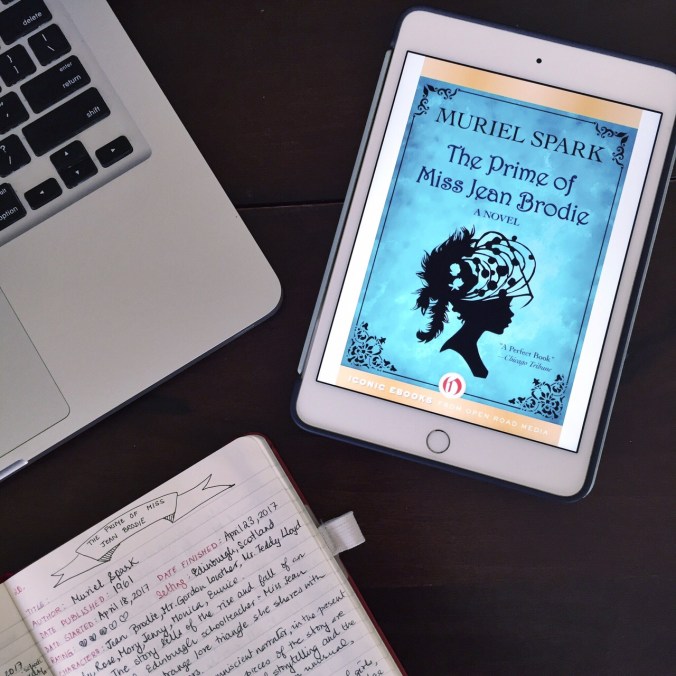
The Prime of Miss Jean Brodie by Muriel Spark

image.jpeg

‘The Prime of Miss Jean Brodie’ by Muriel Spark tells of the rise and fall of an unconventional Edinburgh schoolteacher, Miss Jean Brodie and the strange love triangle she shares with two fellow schoolteachers.

The story is told by an omniscient narrator, in the present and in flash-forwards and hence, the pieces of the story are revealed in fragments. The mode of storytelling and the tension fraught in its format, makes it quick and compelling reading.

At various intervals in her career, Miss Jean Brodie handpicks a a select group of girls from her elite Edinburgh school, whom she trains in private. She educates them in her own particular modes of wisdom and she calls them the ‘créme de la créme’. Jean Brodie’s  specialised curriculum consists of information including but not limited to the Buchmanites and Mussolini, the  Italian Renaissance painters, the advantages of cleansing cream and witch hazel over soap, the meaning of the word ‘menarche’ and the interior decoration of the London house of the author A.A. Milne.

The six selected girls are famous for different things. Monica Douglas for mathematics, Rose Stanley for sex (or I suppose her suspected potential), Eunice Gardiner for gymnastics, Sandy Stranger for her enunciation, Jenny Gray for her grace, and Mary Macgregor for her silence.

Jean Brodie’s unconventional teaching methods are frowned upon by the school authorities, who are continually searching for reasons to dismiss her. It is only the Brodie set that are close enough to Jean Brodie, to be able to acquire incriminating evidence against her and thus betray her. There is one person among the set who betrays Jean Brodie, and the latter  spends her entire life brooding upon the identity of this betrayer. It is beyond her comprehension that someone out of the group of girls-  a group that she has given up the best years of her life and even sacrificed her love life for, should thus stab her in the back.

While the girls are being trained, they were also privy to the emotional and personal life of Jean Brody- a lady in her prime ( a term that is repeated and reinstated in the novel several times) and embroiled in a complex relationship with two scoolmasters – the singing teacher Gordon Lowther and the handsome, one-armed war veteran Teddy Lloyd.

The betrayer of Jean Brodie is someone who also gets involved in this love triangle, thus proving that often jealousy arising from love can overwhelm loyal and decent relationships.

The book is full of such unusual and challenging relationship dynamics. It is also a book about morals and ethics and politics. Jean Brodie in her ‘prime’ forsakes morals and chooses to sleep with the singing teacher, while all the time nurturing a deep, obsessive passion for the art teacher.

There is a displacement of love in the story, such that physical love is only shown to occur between individuals who do not care for one another. A cycle of retribution seems to occur so that Jean Brodie is ultimately punished for her seemingly unrelated action of sleeping with the singing teacher.

The humour in ‘The Prime of Miss Jean Brodie’ is very dark and best described as black comedy. It’s hard for me to exactly pinpoint what the essence of the novel is about. To me it feels like a commentary on the rejection of all things conventional and a lesson on the havoc it may create.

The Ghost of Tennyson in Monica Dickens’ ‘Mariana’

image.jpeg

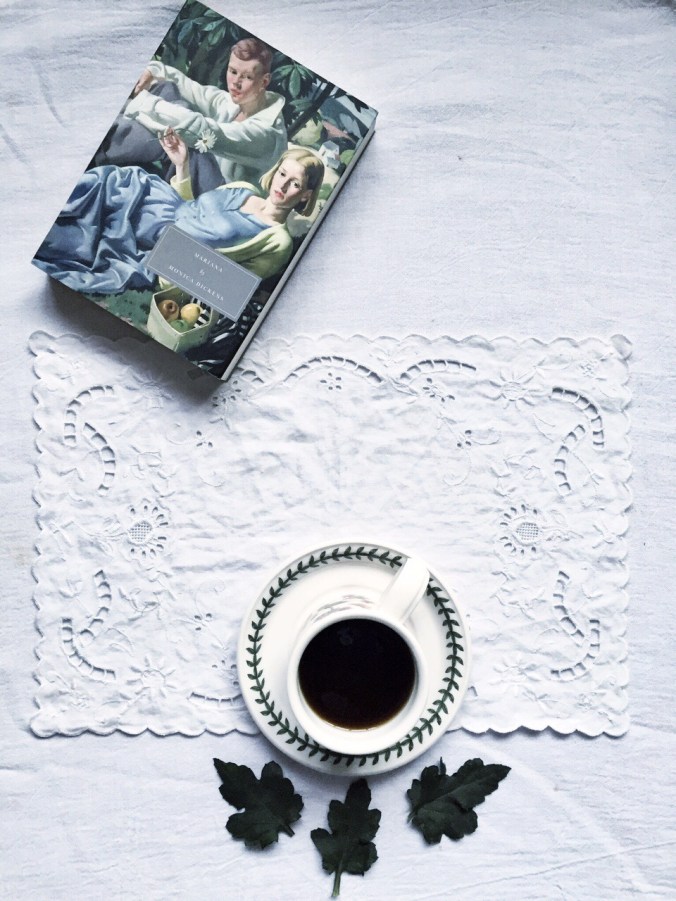
Mariana by Monica Dickens

‘Mariana’ by Monica Dickens is a coming of age novel about a young girl, striving her whole life, to find the perfect love. It’s a story that has great depth and one of the most striking endings I have read in the longest time.

Mary lives with her working mother and uncle in a small flat in London. She remains disconnected to her everyday life in London but highly anticipates the time that she can spend during the holidays, with her extended paternal family in the countryside. Her first love is for her cousin. But the love is rather one sided.

We witness Mary’s emotional awakening as a young child, besotted with cousin Denys. Later as a young woman, we find her engaged to a young Frenchman in Paris, called Pierre. Though Pierre helps her to overcome her loneliness in a foreign city, Mary knows that the relationship is tinged with her doubts. Later, when she is working in England, she finds love in the most unexpected way. Sam, a young architect is everything she has always, unknowingly been looking for. With Sam there are no doubts, no fears or insecurities. But with the outset of the Second World War, lives fall into jeopardy. Can Mary’s love survive the ordeal?

While Mary is enrolled in drama school as a young girl, she is asked to recite Tennyson’s poem ‘Mariana’. As revealed later in the novel, this is quite a pivotal moment in the novel. Mariana is a poem about a woman who is disconnected from society and despondently awaits the return of her love. The poem is laced with doubt and desolation. There is an absence of a conclusive ending in the poem, just as there is in the story by Dickens. But there is a faint whisper or a premonition of what may come to pass. Some endings are best left unsaid.

It is only at the end of the novel that we fully realize that Dickens’ Mary is Tennyson’s Mariana and the full force of Dickens’ genius strikes us.

  • Title: Mariana
  • Author: Monica Dickens
  • Publisher: Persephone Books
  • Year of Publication: 1940
  • Setting: Somerset, England, London and Paris

The Fortnight in September by R.C. Sherriff


Processed with VSCO with a5 preset

‘The Fortnight in September’ by R.C. Sherriff is the evocative account of an ordinary, middle-class family’s annual holiday at the English seaside town of  Bognor Regis. A most vivid story, recording the minutia of human existence, this gem of a story is far from being ordinary. Cozy and comforting and ever so intimate, the slow pace of the novel affords a glimpse of a way of life that has long become obsolete.

It had always been Bognor-ever since, on her honeymoon, her pale eyes had first glimpsed the sea.


The story opens through the eyes of Mrs. Stevens, wife of 20 years and mother to Mary, Dick and Ernie aged twenty, seventeen and ten respectively. We learn very quickly that the Stevens, as a family, are creatures of habit. They have always holidayed at the same time each year, at the same guest-house in Bognor Regis. The meals they eat, the activities they embark on, the traditions that they hold so dear, are a part of their collective history as a family. A history that does not and must not change. Right down to the clothes they pack, how they unpack, how they organize their holiday schedules, even down to the beverages they drink as special holiday treats: Mr. Stevens’ crate of dinner ale, the large stone jar of draught ginger beer holding a week’s supply of refreshment and Mrs. Stevens’ special bottle of port, to be enjoyed a glass at a time after supper.

Throughout the story, the narrative shifts to different members of the family. R.C. Sherriff uses the narrative shift as a useful plot device so that we are afforded a more personal glimpse of the character and inner thoughts of each family member. Each of them has a small but personal story to tell.

Mr. Stevens, middle-aged, staid and respectable has a wistful story to tell. It touches upon loss of prestige and the unfulfillment of ambitious dreams. Mrs. Stevens does not share the same enthusiasm for the family holiday as the others, and strives to keep this to herself. The best part of her day is when she has the guesthouse to herself in the evenings, to sip on her glass of port wine and not think about the call of mundane household chores. Mary, twenty years old, young and innocent, longs to find holiday romance to break the monotony of her sheltered life. Dick, recently graduated from school, on the cusp of youth and locked in a boring but respectable job, plots ways to break free from middle class shackles. Ernie is too young and carefree to think of matters more complicated than the working and design of automatic machinery.

Holidaying at the seaside town has become a tradition for the Stevens family. Every inch, nook and corner holds some sort of memory for them.

There were associations: sentiments. The ink stain on the sitting room tablecloth which Dick made as a little boy: the ornament that Mary made by glueing seashells on a card; which had been presented to Mrs. Huggett at the end of one holiday, and was always on the sitting-room mantelpiece when they arrived each year.

‘The Fortnight in September’ is tinged with an air of wistfulness for dreams and ambitions that remain unfulfilled. In a way the story is not just the story of the Stevens, it is representative of the English middle-class in the 1930’s, showcasing their trials and tribulations. These were people who were by no means financially deprived but they were always wanting and yearning for a little more in life. The neat row of nondescript houses with the white picket fences and carefully manicured lawns were their lot in life along with the two weeks in a dilapidated guesthouse at Bognor. But if by chance they could gain that promotion at work, then they could aspire for something bigger and not so ordinary.

Mostly the fortnight’s holiday was a time to remember the trials of the past, to nurse old wounds, to contemplate the present and to make plans for the future.

Some readers might complain of the slowness of the narrative style of the book and the lack of plot but I enjoyed this book immensely. Never, to my mind, has a family holiday reached such heights of descriptive perfection.

When I was reading ‘The Fortnight in September’ I kept waiting for something awful to happen- some disturbing revelation about the past of a particular family member, a skeleton in the closet, or a shocking incident to disturb the coziness of the novel- much like the disruptive moment that shakes up a Katherine Mansfield story. I will leave it to you, to find out if R.C. Sherriff takes us down that same path…

Processed with VSCO with a5 preset


A Vivid ‘Portrait of Elmbury’ by John Moore

FullSizeRender

‘Portrait of Elmbury’ by John Moore is the recounting of the author’s life, in the small market town of Elmbury in the interwar years.

It seems that the name Elmbury is a fictitious name. In all probability the town of Elmbury is the author’s childhood hometown of Tewkesbury. The names of the characters that show up frequently in the narrative have also been changed to preserve anonymity. What cannot be disguised, however, is the author’s fondness for his hometown, its valleys and fields, its orchards and woods, its rivers and farms ,along with the assortment of distinguished and motley characters that lend Elmbury, a character all its very own.

We follow the author’s life chronologically, starting from the years 1913-1918, when he was a small child, to his boyhood: 1919-1924, his early working life as an auctioneer’s apprentice at his uncle’s office in Elmbury: 1924-1927, a period of returning to Elmbury after four years writing in London: 1931-1935 and lastly a description of the years leading up to the commencement of the Second World War.

The narrative is extremely dense. One needs to devote absolute concentration during reading lest one misses out a detail of an incident, a character or a description.

One fact emerges quite early on in the narrative and that is the fact that Elmbury is not that idyllic English country town bestowed with bucolic charm. This is no James Herriot style storytelling. We learn of the beauty of Elmbury but it is always coupled with the not so beautiful, the derelict and the ugly. And it rears its ugly face in the form of the disreputable ‘Double Alley’.

Indeed, even among Elmbury’s slums, Double Alley was something to be wondered at. Respectable women drew their skirts closer about them as they passed its nauseous opening; even the doctor and the priest were unwilling adventurers on the rare occasions when they were summoned to visit it; and policemen, who were more frequent visitors, took care to go in pairs when their duties took them there.

The author grows up in what he describes as the ‘loveliest house in Elmbury’, Tudor House, which is plump opposite to the entrance to the squalor of Double Alley. Through the window, the young author and his sibling witness the goings on that occur on the high street of Elmbury, the daily rituals of Elmbury residents and the Punch and Judy like theatrics of the Double Alley residents. We learn of the town scoundrels-Pistol, Bardolph and Nym; the Colonel who makes faces at them through the window and emerges later on in the narrative as one of the author’s dearest friends.

Even though, the author accentuates the dirt and filth of Elmbury, ever so often, we are treated to pictures of pastoral perfection. It is in these descriptions of nature where the author excels.

It was a perfect autumn evening. There was mist like blue smoke hanging about the little wood they called the Dogleg Spinney and down in the vale you could see streaks of whiter mist over the the river. The sun was setting in a mass of airy pink clouds like flying flamingos and the Abbey tower, catching the light, burned like a beacon. The chestnut trees in the churchyard, with brown and yellow leaves, were incandescent also. Sprawled around the Abbey, half in light and half in shadow, lay the lovely and haphazard town.

If I had one word of criticism about the narrative it is this that: I found the author distanced his own personal life tremendously from the text. We know scant details of his life: that his father was the mayor of the village, that he lost his father early on in life, that he joined his uncle’s office as an auctioneer, that he disliked certain aspects of his job especially auctioning off the belongings of poor farmers in debt, that he started writing books and left for London to be part of the fashionable writing set, that he returned to Elmbury, after those years in exile with a greater appreciation for the place.

Emotion seemed larger here, pleasures were keener, sorrows sharper, men’s laughter was more boisterous, jokes were funnier, the tragedy was more profound and the comedy more riotous, the huge fantasy of life was altogether more fantastic. London, for all its street lights, was a twilit world; Elmbury on a murky February evening, seemed as bright as a stage.

When the author does return to Elmbury, it is the time of the Great Depression and this time of hardship is felt as keenly in Elmbury as any other place in Britain. It can be witnessed in the long line of people standing outside the Labour Exchange, of the large number of people loitering without a purpose on street corners, in the abject expression in the faces of the villagers…

Then there is a period of ‘uneasy peace’, a lull before the great storm of the Second World War. The people of Elmbury, are called away- some to distant foreign fields to wage a bloody war and some like the author take to the skies in mortal combat.

For my part, I had determined that when war came-we no longer thought of it as ‘if’- I should fight it in the air; for I had just learned to fly a Moth, had discovered a brave new world of cirrus and cumulus, and was bemused by the strange beauty of the sky’s snowy regions, its unearthly continents of clouds.


Many of these people never return to the green verdant fields of Elmbury…

‘Portrait of Elmbury’ is, as the title suggests, a vivid and minutely detailed historical sketch of the market town as seen through the eyes of the author. What is very evident is the author’s great love for the place. I enjoyed it for a unique glimpse at a way of life that occupies a special place in the rural history of England.

I’m eager to read the second book in the trilogy- ‘Brensham Village’,  to see exactly where the story takes us.


I received a review copy of ‘Portrait of Elmbury’ from the kind people at Slightly Foxed but all opinions about this wonderful narrative are entirely my own.

Bleak House is Not a Bleak Novel

2f2b-ee7b-9209-aa73

“LONDON. Michaelmas Term lately over, and the Lord Chancellor sitting in Lincoln’s Inn Hall. Implacable November weather. As much mud in the streets as if the waters had but newly retired from the face of the earth, and it would not be wonderful to meet a Megalosaurus, forty feet long or so, waddling like an elephantine lizard up Holborn Hill.”

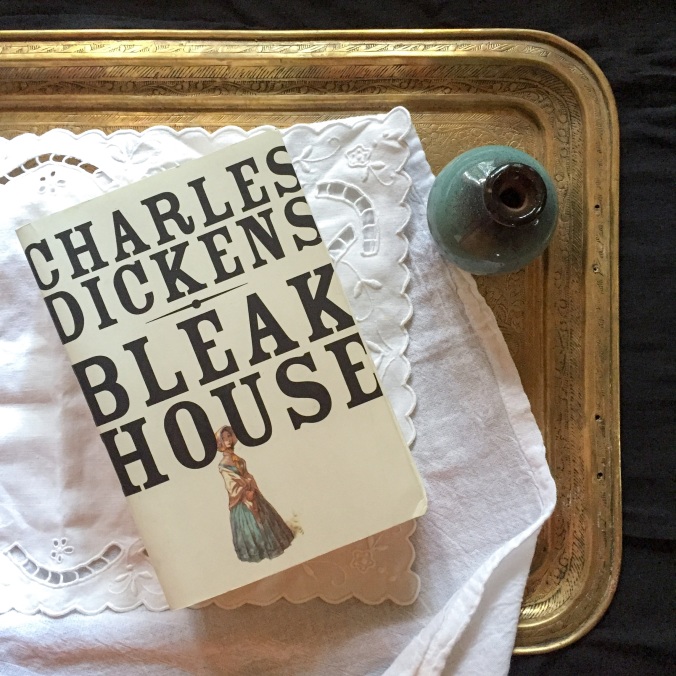
Thus starts the novel of epic proportions named ‘Bleak House’.

The opening paragraph of Bleak House grabbed my attention from the very onset of reading the book. It is truly memorable.

G. K. Chesterton wrote of the introduction of Bleak House that

‘Dickens’s openings are almost always good; but the opening of Bleak House is good in a quite new and striking sense’.

Notice how fragmented the sentences are.

The opening is in fact a one word sentence. The fragmented dialogue, in my opinion, give a sense of frenetic activity. Combined with the present tense that it is written in, there is a sense of unrest, tension and suspense- one feels anything could happen at any time.

And the dull, smokey, dusty, foggy picture of London thus presented, serves almost as a metaphor for the state of Victorian society – in dire need of social reform.

It is the perfect way to introduce the reader to the frustration the author feels regarding the cumbersome judicial system which is one of the themes at the heart of this great novel.

‘Bleak House’ is the story of a legal case called ‘Jarndyce and Jarndyce’ which has gone down in the annals of history, for being one of the most long-standing legal battles in British judicial history. Several people’s financial fates are entangled in the trappings of the legal battle. Of them, we are introduced to Mr. John Jarndyce, owner of Bleak House and his wards, Richard and Ada. There are other beneficiaries but despite the different age, social backgrounds and diversity of the persons involved, they all share one thing in common: the feeling that their lives are in a permanent state of unrest. There is a lack of settlement and finality. There is a hope that an outcome will soon be reached in the case and an expectation that life will vastly improve when that occurs. But in the meantime life is exceedingly hard to bear. There is bitterness and resentment.

When middle aged John Jarndyce, offers his wards Richard and Ada a home under his own roof, he extends the same gesture to young Esther Summerson, a young orphaned girl, who knows nothing about her parents, her past or the reason that she should be so favoured by Mr John Jarndyce. Esther’s personal history is a mystery but it is known to her, that the circumstances of her birth are tinged with shame. Esther is brought to Bleak House as Ada’s companion and is soon entrusted with the housekeeping duties of Bleak House. She has a sweet, kind temperament and it is through her eyes that we are told part of the story.

Bleak House is considered by many to be Dickens’ masterpiece. For one, the narrative technique is extraordinary. In Bleak House we observe Dickens using two different types of narrative.

The first is the omniscient narrator who is impersonally telling the story in the third person. The second is the first person narrative via the character of Esther.

Whilst reading the story I immediately felt I was drawn intimately into the story in the ‘Esther chapters’. The tone of the young girl is fresh and innocent although meek and considerably self-deprecating. This contrasts sharply with the satirical rather jaded tone of the omniscient narrator.

In providing this vivid contrast in narrative and the tense in which the story is told (present tense for the omniscient narrator, past tense for Esther) we are alternately pulled in and out of the narrative.

The use of the omniscient narrator broadens the scope of the novel, however. There are certain situations that Esther cannot be part of although we do see the narratives intersecting in certain parts of the novel.

There is another story running in parallel to the ongoings at Bleak House and introduced to the reader by the omniscient narrator. This is the story of Lady Dedlock, an aristocratic, middle aged lady and wife of Sir. Leicester Dedlock, Baronet. We learn that she is sad, exceedingly bored with life, excessively privileged but she has a secret to hide and that secret is known to the family lawyer, Mr Tulkinghorn.

There are other remarkable characters: the ‘childlike’ Mr Skimpole, the mercenary Mr. Smallweed, down on his luck George Rouncewell, conniving Mr Tulkinghorn, annoying Mr Guppy , charitable but short-sighted Mrs Jellyby and more. What amazed me was how Dickens was able to bring all the loose threads of these seemingly unrelated narratives and weave a cohesive tapestry of a cogent story.

It is impossible to do a book of Bleak Houses’s stature true justice through a book review. Nevertheless, I will strive to list some of the reasons why this book mattered so much to me.

1. Spontaneous combustion 💥(need I say more?).

2. A detailed historical glimpse of Victorian London.

“Smoke lowering down from chimney-pots, making a soft black drizzle, with flakes of soot in it as big as full-grown snow-flakes — gone into mourning, one might imagine, for the death of the sun. Dogs, undistinguishable in mire. Horses, scarcely better; splashed to their very blinkers. Foot passengers, jostling one another’s umbrellas in a general infection of ill-temper, and losing their foot-hold at street-corners, where tens of thousands of other foot passengers have been slipping and sliding since the day broke (if the day ever broke), adding new deposits to the crust upon crust of mud, sticking at those points tenaciously to the pavement, and accumulating at compound interest.”

3. A social commentary on the poor and their pitiful state.

“I thought it very touching to see these two women, coarse and shabby and beaten, so united; to see what they could be to one another; to see how they felt for one another, how the heart of each to each was softened by the hard trials of their lives. I think the best side of such people is almost hidden from us. What the poor are to the poor is little known, excepting to themselves and God.”

4. A seething description of the havoc that legal proceedings can have on the life of common man.

“The lawyers have twisted it into such a state of bedevilment that the original merits of the case have long disappeared from the face of the earth. It’s about a will and the trusts under a will — or it was once. It’s about nothing but costs now. We are always appearing, and disappearing, and swearing, and interrogating, and filing, and cross-filing, and arguing, and sealing, and motioning, and referring, and reporting, and revolving about the Lord Chancellor and all his satellites, and equitably waltzing ourselves off to dusty death, about costs. That’s the great question. All the rest, by some extraordinary means, has melted away.”

5. The emphasis on relationships, particularly the love between children and parents.

6. Wicked satire.

7. Excellent characters that seem real enough and relevant, even today.

8. Beautiful descriptive writing.

“I found every breath of air, and every scent, and every flower and leaf and blade of grass and every passing cloud, and everything in nature, more beautiful and wonderful to me than I had ever found it yet. This was my first gain from my illness. How little I had lost, when the wide world was so full of delight for me.”

9. Superlative narrative structure and plot construction

10. Aspects of a murder mystery story that I think Agatha Christie would have approved of.

I spent an entire month reading the 1000 or more pages of Bleak House. It was time very well spent. Could the novel have done with some editing? Perhaps. But then again, it wouldn’t be the same. The ending of Bleak House is satisfying. All the loose ends of the plot are perfectly tied and Dickens, realistically doesn’t provide happiness to all the outcomes. Bleak House is not a bleak novel. It is a beautiful social commentary and the narrator, Esther Summerson is one of the sweetest people to grace the pages of Victorian fiction.
IMG_6117


Miss Pettigrew Lives for a Day by Winifred Watson

IMG_1289


I always wanted to taste whiskey,’ said Miss Pettigrew happily. I’ve never had it, ever, even when I’ve had a cold, as medicine.’

‘Where were you brought up?’ commiserated Michael.

‘Sip it slowly,’ begged Miss LaFosse.

‘Bottoms up,’ said Michael.

Miss Pettigrew sipped. She pulled a face. She slipped her class surreptitiously on the table.

‘Ugh!’ thought Miss Pettigrew, disappointed. Not what it’s cracked up to be. Why men waste money getting drunk on that, when they can get a really cheap palatable drink like lemon squash …!’


Laughing and thinking about this passage from Winifred Watson’s memorable novel ‘Miss Pettigrew Lives for a Day’ (1938).

I am reviewing this book as part of the #1938club, initiated by Simon David Thomas of Stuck in a Book and Karen of Kaggsy’s Bookish Ramblings. To take a look at other books published in the same year, reviewed by other bloggers, please take a look at this blogpost and this one.


This Persephone Classic, recounts the events of the most remarkable day in the life of Miss Guinevere Pettigrew.  The day starts quite drearily with Miss Pettigrew desperately seeking a job to avoid being thrown out of her abode. Miss Pettigrew is mistakenly sent by the employment agency, to the apartment of young singer and aspiring actress Miss Delysia LaFosse.  Miss Pettigrew thinks she is applying for the post of a governess and Delysia requires a maid to keep her affairs in order.

In the misunderstanding that ensues, Miss Pettigrew exhibits immense presence of mind and efficiency in helping Miss La Fosse out of several scrapes, most of which involve young men. Miss Pettigrew is called upon to save Delysia from several precarious situations. She lies for the first time in her life, is called upon to show some acting skills (something she had not known that she had within her!) and also drink and socialize with Delysia’s group of friends.

For the first time in her life Miss Pettigrew feels needed, loved and competent. She undergoes a metamorphosis so dramatic and sudden that by the end of the day she is hardly the same person who had timidly knocked upon Mis LaFosse’s front door. It is a day that changes Miss Pettigrew’s life and the lives of several people she touches, forever.

Charming and funny and tinged with the naïveté of Miss Pettigrew’s unimpeachable character, it is a story that is laced with the wistfulness and regret of missed chances and opportunities of forgotten youth. However, there is great hopefulness in the novel. Miss Pettigrew reminds me in little subtle ways of Anne in Jane Austen’s Persuasion and she has the matchmaking tendencies of Austen’s Emma, only she is far wiser and manages situations much better.

Miss Pettigrew Lives For A Day is a charming novel. It is book that will invoke giggles. I will most certainly be reaching out for it in a couple of years for a re-read.

The Priory by Dorothy Whipple

img_2027-2

Title: The Priory

Author: Dorothy Whipple

Published: 1939

Republished by Persephone Books

Setting: Rural Midlands in the Interwar Years

Main Characters: Major Marwood, Anthea Marwood (his second wife), Christine Marwood (elder daughter of Major Marwood), Penelope Marwood (younger daughter of Major Marwood), Nurse Pye, Aunt Victoria (spinster sister of Major Marwood), Mr. James Ashwell (wealthy former mill owner), Nicholas Ashwell (son of James Ashwell).

She saw for the first time that the history of Saunby was a sad one. It had been diverted from its purpose; it had been narrowed from a great purpose to a little one. It had been built for the service of God and the people; all people, but especially the poor.

‘And now it serves only us,’ she thought.

                                                                           – Christine Marwood.

In Dorothy Whipple’s novel, ‘The Priory’ , Saunby Priory is a large landed estate associated with the ruins of a medieval Priory. In olden times, pilgrims had sought rest here, on their way to Canterbury from the North. Kindly monks had allayed their hunger and tiredness with bread, beer and a place to sleep at night. After the Dissolution of the Monasteries during the Reformation the Priory passed on to the Perwyns and thereafter to the Marwood family in 1793.

The story commences a few years prior to the onset of the Second World War. The state of affairs of Major Marwood’s country estate, Saunby Priory, lies as dilapidated as the ancient ruins that lie on the western edge of the manor house. The Major is a widower, his two young daughters, Penelope and Christine, aged 19 and 20, run wild all day on his estate, his elderly sister Victoria is unable to guide his household affairs and he lies on the verge of financial ruin. Every year to save himself and Saunby he sells a small parcel of property associated with his estate. Then, at the august age of fifty, he meets Anthea Sumpton and recognizes in her a woman who to his mind has the ideal characteristics of a second wife, i.e. she is sensible, devoted and no longer young. Importantly, she will in all probability not want to start a family. He marries her so that someone at last will take his household to hand and manage his life: his servants, his children and his annual fortnight of summer cricket.

Anthea Marwood feels that she is an unwanted intruder in the Marwood household.

The occupants of Saunby looked at her when she came into a room as people in a railway carriage look at a traveller who gets in later on the journey. The Marwoods, she was beginning to find out, were the sort of people who like a carriage to themselves

Despite the initial setback Anthea faces, she quite slowly but steadily starts to carve a niche for herself in the household.

Quite early on in the marriage, Major Marwood realizes with dismay that his marriage of convenience is turning out to be very inconvenient for him. Anthea, contrary to plans is expecting a child, an added expense in his mountain of debts. Anthea, focuses all her attention in gathering provisions for her child and securing his/hers future.

In the meantime, in a whirlwind romance, Christine Marwood falls in love with Nicholas Ashwell, son of a wealthy former mill-owner when he visits Saunby during the cricketing fortnight. Their infatuation results in a marriage proposal that Christine accepts. Christine on the eve of her marriage is faced with the unwelcome prospect of leaving Saunby, a place that has been her sanctuary for the entirety of her life.

‘I don’t want to go’ thought Christine…

‘I want to stay here, as I am.’

Nicholas was a stranger. A few months ago she had never heard of him and now she was going away with him, throwing in her lot with his. What was love that it made you think you could live with a stranger? You ought to find out first, you ought to be sure.”

As Christine embarks on a new, unfamiliar life in the coastal seaside town of Mansbridge, she finds herself missing Saunby more and more. She realizes that married life with Nicholas is not enough to fill the gap left in her heart by her absence from Saunby. Her married life is far from idyllic- Nicholas’s idle lifestyle, gaming, drinking and frittering his life away makes her long for her former home more and more.

Whilst visiting Saunby during her sister Penelope’s wedding she is reluctant to go home to Mansbridge and her husband.

There were some black and yellow striped caterpillars that covered the tansy plants at Saunby…If you moved them to another plant they either died or made their way back to the tansy. Christine, noticing them again now, wondered if she was going to be like that about Saunby; unable to live anywhere else.

However, life decides to take a sharp turn for the worse for Christine and she finds herself separated from her husband, each of them fighting their own separate battles under heart wrenching circumstances. Can Saunby save their future, their feeling of self-worth and purpose in life?

It is difficult to summarize the scope of a large 500 page novel like ‘The Priory’ within the space of a few paragraphs. The book is so much more than the collective story of personal incidents, trials and tribulations of a household. Whilst reading the story it is hard to gauge the actual focus of the story. Is ‘The Priory’ the story of Anthea Marwood’s gradual adjustment to her new household, her determination to secure a stable future for her children, the story of Christine Marwood’s move to the Ashwell family at Mansbridge and her yearning for Saunby or is it the story of Nicholas Ashwell’s frustration in life for being nothing more than a rich man’s son incapable of finding his own way in life? ‘The Priory’ is the summation of all these stories and more. It deals us a sharp lesson in the fragility of good fortune in life.

At the heart of the story is the medieval Priory and the attached house at Saunby. Serving the purpose of just a roof over the heads of a single household it is a drain of individual resources and is too large and unruly to manage by a single person. Essentially, ‘The Priory’ is the story of how the future of Saunby Priory might be diverted to recover the livelihoods, dignity and self-worth of a large community of people, united in their purpose. It is a beautiful novel, worthy of the highest praise and Whipple is an author, whose writing I look forward to reading more of, in the near future.

Nightingale Wood by Stella Gibbons

IMG_0374

Title: Nightingale Wood

Author: Stella Gibbons

Published: 1938

Main Characters: Viola or young Mrs. Wither ( 21 year old widow of Teddy ), Mr. Wither (Viola’s father-in-law), Mrs Wither (Viola’s mother-in-law), Madge (elder daughter of the Withers), Tina (younger daughter of the Withers), Saxon Caker (the Wither’s chauffeur and Tina’s love interest), Victor Spring (rich neighbor of the Withers and Viola’s love interest), Hetty (Victor Spring’s orphaned cousin).

Book Setting: Rural Essex (England) in the late 1930s.

Short Synopsis of the Story:  Recently widowed and impoverished Viola Withers finds herself forced to live with her in-laws -the Withers in their dull, gloomy country house in Essex. Mr. Wither is obsessed with his money and investments. Madge the elder daughter longs for a companion and finds it in a newly adopted dog.  Viola finds a companion in Tina who has a secret obsession for their handsome chauffeur Saxon. Viola meets their rich neighbour Victor Spring and finds in him her Prince Charming. Whether Victor Spring reciprocates her love and fully appreciates the seriousness of her regard is however another matter.

Thoughts About the Book: Superficially, Nightingale Wood is the quintessential Cinderella story. If the relationship between Viola and Victor Spring had been the soul focus of the book- then perhaps Nightingale Wood would have been a good but unremarkable story. However, the book has many layers to it. There are many relationships and stories that are simultaneously unravelling before our eyes. There is the unconventional relationship between Tina and Saxon. Herein, Gibbons shows us that money and status can overnight convert the opinions and regard of the English middle class. Whilst Viola longs for the sparkling, gaiety filled social life that the Spring’s enjoy, Hetty longs to leave her privileged existence at the Spring household and is fascinated by the gloom, austerity and ‘Chekhovian’ atmosphere of Mr.Wither’s house.

Gibbons narrates the story with great finesse. The fairy tale like romantic scenes of the book are described with beautiful language and description. Where I find Gibbons excels is her ability to bring the reader down to earth with her juxtaposition of romantic description with down to earth wit.

The following is a description of events and Tina’s feelings upon returning home to their dour house after a romantic summer ball and saying goodnight to her love Saxon.

The moonlight, the stillness of the woods, the solemn glimmer of tiny stars, acted powerfully upon her senses. How pure the moonlit air smelled! moving very slowly across miles of country where hawthorn and bean-blossom, orchards and gardens, could yet out-perfume the towns and garages, as they had conquered the middens of Charles II’s day. The old earth keeps her sweetness. And I have to go indoors, to bed, thought Tina, with all this beauty outside. I should like to drive all night, away to the sea. She could hear, in fancy, the long waves rolling in.

Mr Wither shut the front door.

‘Oh dear, I am so tired.’ Mrs Wither patted away a yawn and ruefully bent to rub her evening shoe, wherein a faithful corn was undergoing martyrdom.

Conclusion: I thoroughly enjoyed this book. There were many interesting characters and events to enjoy along with Gibbon’s exceptional descriptive storytelling and humour.