Mrs Dalloway by Virginia Woolf: First Impressions

image.jpeg

‘Mrs Dalloway’ by Virginia Woolf, follows a day in the life of Clarissa Dalloway, middle aged, graying wife of eminent British politician, Richard Dalloway. It is no ordinary day, however. It is the day on which Clarissa will host a glittering evening party, where the creme-de-la-creme of British high society, including the Prime Minister himself, will grace the Dalloway’s Westminster residence.

The novel in its most simplistic form can be viewed as a day in the life of a lonely, married woman but it is so much more than that. It is a novel dealing with many topics of far-reaching significance, not limited to mental illness, the aftermath of the First World War, class structure and homoerotic love.

The narrative structure switches fluidly from the third person to the first person, giving the reader an intimate view of the external and internal worlds of the characters in the novel. The use of free indirect discourse makes us privy to moments of flawless and breathtaking intimacy.

The novel (originally called ‘The Hours’) is leant great structure by the division of the hours of the day by the regular, metallic intonations of Big Ben’s chimes. The regular reverberations help to provide pause to a novel, otherwise lacking in chapters or page breaks- ‘the leaden circles dissolved in the air’.

Despite the novel covering the incidents encompassing a single day, we find time expands and we effortlessly dip into Clarissa Dalloway’s past- her memories at Bourton and the friends she had in her youth. We meet her childhood sweetheart Peter Walsh and also the love of her life Sally Seton. We also meet Richard Dalloway, whom she eventually decides to marry.

The plot of the novel is rather loose but it holds the threads of the stories of several individuals who are directly or indirectly related to one another.

There is the thread of former sweetheart Peter Walsh, freshly returned from India, and trying to secure the divorce of a fresh flame- a married woman in India. He briefly visits Clarissa on the morning of her party and is struck with how much he still loves her.

There is the thread of Richard Dalloway, who shares a sterile yet companionable relationship with his wife of many years. There is a memorable moment when he spontaneously decides to bring Clarissa flowers in the afternoon but despite exerting considerable effort, finds himself unable to tell her that he loves her.

Then there is the thread of daughter Elizabeth Dalloway and her relationship with tutor Miss Kilman. Clarissa finds herself disturbed with their close relationship whereas staid Richard Dalloway brushes it off as being nothing.

Most importantly there is the thread of Septimus Warren Smith, war veteran, victim of shell shock and his Italian wife Lucrezia Warren-Smith. Theirs is a poignant story, where the wife recognizing signs that her husband has lost the will to live, battles to secure his mental well-being and lives in constant fear that he will take his own life.

The collective threads of the story are brought together in climax at Clarissa’s evening party, when Peter Walsh, Sally Seton, other friends, family and members of the Dalloway social circle (including Septimus’ physician Sir William Bradshaw) congregate at their home. It is here that the news of Septimus Warren-Smith’s death by suicide  reaches the ears of Clarissa. Her spontaneous reaction to the news is one of annoyance that the Bradshaws should sully the mood of her party with this unwanted piece of information. By being privy to Clarissa’s inner thoughts we witness her raw, self-centred but honest reaction to the death of a man she never knew. Despite her jarring initial reaction, we later find Clarissa, drawing away from the party and musing privately about the life of the man and the circumstances of his death.

In a way Woolf uses ‘Mrs Dalloway’ as a medium to criticize the treatment and understanding of mental health issues, a subject that was very near to her heart.

Perhaps parts of Woolf herself are strewn in bits and pieces across the broad scope of the novel. She inhabits the personas of many of her main characters but it is evident that she doesn’t wholly inhabit any of them. She and Leonard Woolf are not as upper middle class as the Dalloways, neither is she the slightly mindless socialite that is Clarissa Dalloway. Woolf does share the mental issues of Septimus Warren- Smith ,however, and traces of her relationships with men and women are to be found in ‘Mrs Dalloway’.

‘Mrs Dalloway’ is a book that I have a feeling I will read many times, to distill further insights and information upon successive  readings. Moreover, delving into that beautiful prose is a treat unto itself, even though the reading experience is not the easiest.

Title: Mrs Dalloway

Author: Virginia Woolf

First published: 1925

Characters: Clarissa Dalloway, Richard Dalloway, Peter Walsh, Sally Seton, Septimus Warren-Smith

The Home-Maker by Dorothy Canfield-Fisher

image.jpeg

In her 1924 novel, The Home-Maker, Canfield-Fisher targets the issue of gender roles in society.
In the novel, a middle-class American couple, a victim of circumstances, are forced to switch their working roles. The husband, suffering from paralysis takes up the mantle of duty in the home, while his wife goes to work in a departmental store. It is here that she flourishes and in many ways finds an outlet for her more creative and innovative ideas. The husband fulfills a more nurturing, patient role with their children in the household. The entire family finds a balance that was hitherto unknown to them.


In this book, far ahead of its times, Canfield-Fisher raises awareness, that it is not gender but personality that predisposes men and women to roles in the work sphere, be it inside or outside the home.


About Dorothy Canfield-Fisher

Dorothy Canfield-Fisher, whom Eleanor Roosevelt named: one of the ten most influential women in the US, was one of the forerunners of American literature, who as early as the first decades of the twentieth century spoke up for racial equality and female rights.


#femmemarch

This post was in celebration of the #femmemarch that Resh @thebooksatchel has created to honour the power of women in literature.


Wild Strawberries by Angela Thirkell

image

Young Mary Preston has been invited to spend the summer at the sprawling country estate of  Rushwater, belonging to Lady Emily Leslie. ‘Wild Strawberries’ is the story of that very idyllic time, Mary Preston’s romantic entanglements and the summertime activities of the landed country gentry.

Rather than being made to feel like the poor relation, down and out on her luck, Mary is welcomed by her Aunt Agnes (Aunt by marriage) and Aunt Agnes’ mother- the very vague but likable character of Lady Emily. Aunt Agnes and Lady Emily have secret plans to forge a match between Mary and the widowed second son of Lady Emily- John Leslie. Despite John cutting a very tragic figure, there are more Mr Leslies’ for Mary to contend with. There’s the youngest son- David Leslie, charming but rather unreliable. Will Mary be able to follow the true callings of her heart during this glorious summer at Rushwater?

‘Wild Strawberries’ was a beautiful, bucolic summer read.  What really endeared this book to me were its host of rather wonderful characters: the vague Lady Emily forever looking for something, the doting young mother Agnes, always making excuses for her children’s behaviour and flitting about without a care in the world, the charming self-centred playboy David Leslie and the mature, thoughtful mannered widower John Leslie.

Throw in the French neighbours, the pompous figure of Mr Holt, a few midnight balls, summer walks and shopping trips down to London and you have the makings of yet another stellar read from the very funny Angela Thirkell.

As with other Thirkell novels, the beauty of the novels don’t lie in the weak plots but in the rather full bodied, lovable characters. They have mannerisms and flaws in their characters but they are always very believable. Thirkell imparts to them such well timed, comedic humour that these books are a joy to read.

Title: Wild Strawberries

Author: Angela Thirkell

Published: 1934

Setting: Rushwater Estate, Barsetshire, England

Characters: Mary Preston, Aunt Agnes, Lady Emily, John Leslie, David Leslie, Madame Boulle, Joan Stevenson, Gudgeon.

The Ghost of Tennyson in Monica Dickens’ ‘Mariana’

image.jpeg

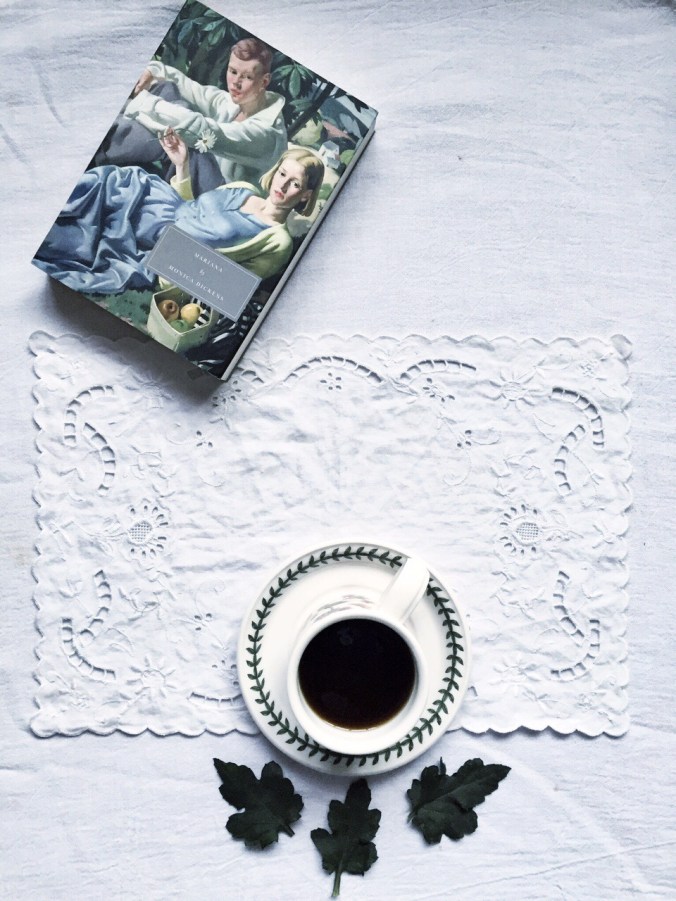
Mariana by Monica Dickens

‘Mariana’ by Monica Dickens is a coming of age novel about a young girl, striving her whole life, to find the perfect love. It’s a story that has great depth and one of the most striking endings I have read in the longest time.

Mary lives with her working mother and uncle in a small flat in London. She remains disconnected to her everyday life in London but highly anticipates the time that she can spend during the holidays, with her extended paternal family in the countryside. Her first love is for her cousin. But the love is rather one sided.

We witness Mary’s emotional awakening as a young child, besotted with cousin Denys. Later as a young woman, we find her engaged to a young Frenchman in Paris, called Pierre. Though Pierre helps her to overcome her loneliness in a foreign city, Mary knows that the relationship is tinged with her doubts. Later, when she is working in England, she finds love in the most unexpected way. Sam, a young architect is everything she has always, unknowingly been looking for. With Sam there are no doubts, no fears or insecurities. But with the outset of the Second World War, lives fall into jeopardy. Can Mary’s love survive the ordeal?

While Mary is enrolled in drama school as a young girl, she is asked to recite Tennyson’s poem ‘Mariana’. As revealed later in the novel, this is quite a pivotal moment in the novel. Mariana is a poem about a woman who is disconnected from society and despondently awaits the return of her love. The poem is laced with doubt and desolation. There is an absence of a conclusive ending in the poem, just as there is in the story by Dickens. But there is a faint whisper or a premonition of what may come to pass. Some endings are best left unsaid.

It is only at the end of the novel that we fully realize that Dickens’ Mary is Tennyson’s Mariana and the full force of Dickens’ genius strikes us.

  • Title: Mariana
  • Author: Monica Dickens
  • Publisher: Persephone Books
  • Year of Publication: 1940
  • Setting: Somerset, England, London and Paris

The Tenant of Wildfell Hall

image.jpegStartlingly, ahead  of the time, this is a story dealing with the themes of drunkenness and debauchery and the strong will of a Victorian woman, determined to change her fate.
Anne Brontë’s writing deviates from both her sisters, in having an air of realism in it’s narrative  The style is wonderfully lucid and the storytelling very proficient.

The Plot of the Tenant of Wildfell Hall

The ‘Tenant of Wildfell Hall’ tells of the story of a young mother, Helen Graham and her small son, who quite mysteriously come to live one day at the quite dilapidated Wildfell Hall. The neighborhood is thrown into quite a tumult and everyone is quite curious to know more about Helen Graham’s personal history and how she came to be alone.

Helen’s reclusive air and dislike for company, added to the resemblance of her son Arthur to the local Mr Lawrence, further fuels nasty rumors. The gossip reaches the ears of landowner and farmer Gilbert Markham.

Gilbert forms a close friendship with Helen Graham. The friendship threatens to assume a more romantic turn and Helen tries to discourage Gilbert’s amorous efforts. However, one day she is compelled to reveal the mystery of her past by letting him read her lengthy diary entries.

Upon reading the diary, Gilbert comes to know of her tragic married history. Married to an alcoholic and abusive husband named Arthur Huntingdon, Helen is forced to flee from the persecution of her husband in order to protect her son.

It is quite a modern story and I imagine, must have shocked Victorian audiences when it was published in 1848. To have a woman, openly resisting her husband’s torture, trying to live separately and capable of acquiring an independent means of income, was certainly ground-breaking for the time.

I enjoyed the story overall but had a minor quibble with the weak narrative device- that of a letter written by Markham to a friend describing all events and including the lengthy diary.

One can’t help wondering, with the literary genius that Anne Brontë and her sisters had, what kind of works they would have produced in later life, if they had been permitted to live longer.

  • Title: The Tenant of Wildfell Hall
  • Author: Anne Brontë
  • Date published: 1848
  • Setting: Yorkshire, England, 1827.
  • Characters: Helen Graham, Gilbert Markham, Arthur Huntingdon.

Cluny Brown by Margery Sharp

img_5935

The Charming  and Unusual Story of Cluny Brown

‘Cluny Brown’ by Margery Sharp was just as quirky, just as delightful and just as thoughtful as Sharp’s other books. The book leads us through the life of an unusual girl who prefers to tread down the unconventional path in life.

In the story we are introduced to an orphaned young lady called Cluny Brown. She’s quite an interesting character, memorable, like Sharp’s other protagonists.

But she has one serious fault- she doesn’t seem to know her ‘place’ in the world- at least according to her Uncle, Mr Porritt and her interfering Aunt Addie. Just as an example, she’s been known to have had tea at the Ritz, which according to them, is seen to be vastly above her station.

She works as a phone receptionist of sorts for her plumber-uncle. And though she gets into a few scrapes along the way, things come to a serious head when she actually goes to visit one of her uncle’s clients, tries to fix the plumbing herself, and is discovered in a compromising position by who else than her uncle.

Her Uncle and Aunt Addie decide that enough is enough and Cluny must go into some sort of service and find her own way in the world. And so when the position of a house maid comes up in a respectable, rich household in the country, Cluny is sent on her way without giving her a chance to demur.

It seems Cluny has (according to the employment bureau) all the attributes of the perfect parlour-maid – ‘height, plainness and a perfectly blank expression.’ What they don’t account for is her personality!

So Cluny arrives at the expansive Devonshire estate of Friars Carmel. There’s a Lord Carmel of course, a Lady Carmel, a privileged only son, Andrew, recently down from Cambridge and to provide variety, a Polish man of letters called Adam Belinski, who is seeking cover from the Nazis and a guest of the family.

Cluny Brown’s Life at Friars Carmel

Cluny arrives at Friars Carmel, quite by chance, in a Rolls-Royce. The gardener fails to pick her up in the station wagon and it is left to kind and neighbourly Colonel Duff-Graham (who is informed by telephone by the station master) who is at the station to pick up his new Labrador to ‘drop anything for Friars Carmel’. He doesn’t really count on dropping home the new parlour-maid but of course he obliges.

Cluny befriends the new Labrador and is invited to take him out on walks on her afternoons off. On these afternoons of sheer freedom she also stumbles upon the local village pharmacist, his cozy dwelling behind the shop and his heartwarming mother.

The pharamacist’s friendship seems to provide Cluny with everything her life has been missing- order, security and companionship. And when Cluny is confronted with making a serious decision in her life, she doesn’t hesitate to make the decision which is right for her.

Why Margery Sharp’s Cluny Brown is so Unique

Margery Sharp’s Cluny is truly memorable. She’s slightly ‘off’ just like Sharp’s Martha of the ‘Martha trilogy ‘ and that makes her totally endearing to me. She doesn’t follow societal norms but does follow her instincts. And if that means that she will never know her place in life, then so be it.


It does make one think: what truly is a person’s place in society? Who decides it? What controls it? How can birth decide a person’s position? Haven’t we seen innumerable examples in history where people have changed their situation through hard work and initiative?


All food for thought.


This blogpost is in honour of Margery Sharp’s birthday hosted by Jane from Beyond Eden Rock.


A big thank you to Open Road Media for kindly sending me an e-book of Cluny Brown. As always , all opinions regarding the book are entirely my own. 


10 Classics for 2017

image.jpeg


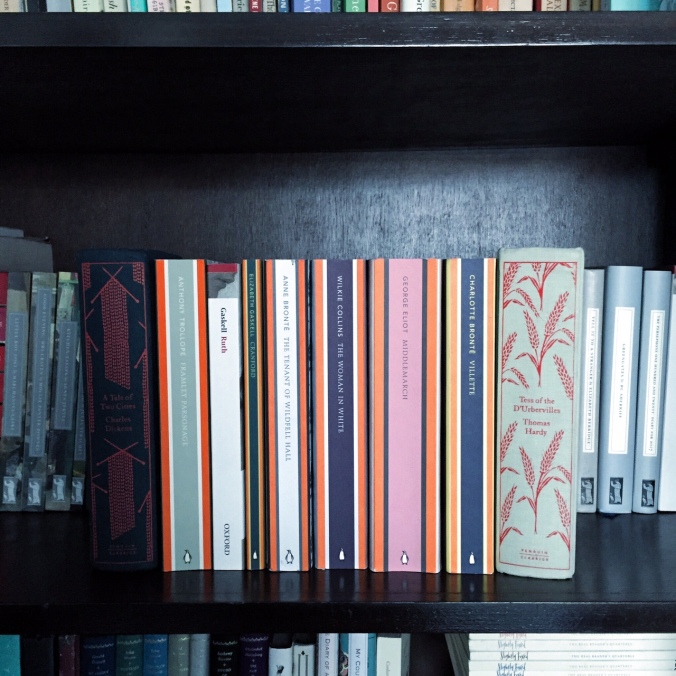
The Ten Classics I Want to Read in 2017

I started seriously reading the classics again in 2016. This year I’ve joined the Classics Club and made a list of 50 books I plan to read in the foreseeable future.

I ended 2015 with a plan to read 12 Classics. I ended up only reading about half that number of books, but the books I read were incredibly enriching and rewarding. And I’m excited to read more classic literature (I classify this as having been published pre-1900) in 2017.


My list of Classics

Charles Dickens:

To Be Read:

A Tale of Two Cities and David Copperfield – last year I started to make a dent in my Dickens’ bibliography. I started with the rather chubby Bleak House and since then I’ve added Great Expectations to the ‘read’ list. Reading Dickens gives me a wonderful insight into Victorian England. Social classes, poverty, moral issues- glimpses of London and wonderful, wonderful language. Dickens’ characters are so memorable too!

Anthony Trollope:

To Be Read: Framley Parsonage

-last year I started reading the Barchester Chronicles with a group of lovely people over at Instagram. I’ve found Trollope’s writing style to be quite witty and descriptive, even if his stories (like Dickens) could do with a shortening edit at times. Framley Parsonage is next on the list and who knows? We may carry on from there to continue the series next year. I’ve found that, so far, the books in the Barchester series can be read as standalones.

Elizabeth Gaskell

To Be Read: Ruth and Cranford

-the high point of my classic’s reading last year was discovering Elizabeth Gaskell, namely, her novel ‘North and South’. I waxed lyrically about the romance and delicate detail in this lovely novel over on Instagram and our group read was made so much nicer through splendid direction from Gaskell enthusiast, Shelbi, from the blog ‘The Nobby Life’. I hope to read ‘Cranford’ next year as it’s a short one and I love the TV adaptation starting Dame Judy Dench.

Anne Bronte:

To Be Read: Tenant of Wildefell Hall

-the neglected Brontë in my life. I hope to rectify this. I have a gorgeous Penguin English Library edition crying out to be read on my shelf too!

Wilkie Collins:

To Be Read: Woman in White

-how can I read Dickens without reading the works of his compatriot and contemporary, Collins. Eager to read this book and ‘The Moonstone’ soon.

Charlotte Bronte:

To Be Read:Villette

-Jane Eyre is perhaps my favourite Classic novel to date. I’m eager to discover ‘Villette’- slated as the author’s personal favourite.

Thomas Hardy:

To Be Read: Tess of the D’Urbervilles

-I’m a big fan of ‘Far From the Madding Crowd’ so having read that and also ‘Mayor of Casterbridge’ I look forward to delving into ‘Tess’. I do enjoy the BBC dramatization too.

George Eliot:

To Be Read: Middlemarch

-I feel a tad sheepish about this one. It was on my TBR for 2016 and somehow I never got to it. Hoping 2017 will see me reacquainted with this much-loved classic.


Concluding Thoughts About My Classics List for 2017

So that’s me done for planning classics reading next year. Who knows what might happen? Perhaps I will read exclusively Gaskell. But I always like to start off with a plan?

How about you?

Top 10 Books of 2016


This was a really satisfying year of reading good literature even though I didn’t read that many books (about 35). I was able to read Dickens, Trollope and Gaskell from the classics and a few interesting biographies and modern classics.

There are several books on my Top 10 list that I know I will be re reading again and that have become great favourites. Read on and discover a few of my favourites (in no particular order).

1) A Month in the Country by J.L. Carr. Full review here.


2) Diary of a Provincial Lady by EM Delafield. Find my review for Novelicious on their website.


3) Bleak House by Charles Dickens. Find review here.

View this post on Instagram

A few days ago we discussed Dickens' opening of Bleak House and so many of you commented on the narrative structure of the novel. Bleak House is considered by many to be Dickens' masterpiece. For one, the narrative technique is extraordinary. In Bleak House we observe Dickens using two different types of narrative. The first is the omniscient narrator who is impersonally telling the story in the third person. The second is the first person narrative via the character of Esther. Whilst reading the story I immediately felt I was drawn intimately into the story in the 'Esther chapters'. The tone of the young girl is fresh and innocent although meek and considerably self-deprecating. This contrasts sharply with the satirical rather jaded tone of the omniscient narrator. In providing this vivid contrast in narrative and the tense in which the story is told (present tense for the omniscient narrator, past tense for Esther) we are alternately pulled in and out of the narrative. The use of the omniscient narrator broadens the scope of the novel, however. There are certain situations that Esther cannot be part of although we do see the narratives intersecting in certain parts of the novel (eg. The event of the young law-writer and lodger at Mr Krook's dwelling). ~ Here are a few questions for us to ponder: ~ What did you think of the narrative technique? Did it feel modern to you? Did you feel that the transitions were awkward or did they provide you with a respite from the intensity of a first person narrative for a novel of this immense length? Do you feel Esther is a reliable narrator at this point in the story? What do you feel about Esther's character so far? She opens her commentary with the disclosure that she is 'not clever'. Did you gain this same impression from her narrative technique? Is she how you imagine a Victorian woman to be represented? ~ We are a fourth of the way into the novel. Are you enjoying it so far? Feel free to also post your own discussion questions too below. I have not added any spoilers (I think!) but please realize a few may crop up in the comments below.

A post shared by Arpita Bhattacharya (@bagfullofbooks) on


4) Someone at a Distance by Dorothy Whipple. Find review here.


View this post on Instagram

'Someone At a Distance' by Dorothy Whipple and published by @persephonebooks is a story about adultery. It is a story about a husband’s weakness, a wife’s short-sightedness and a young, ambitious girl’s yearning to rise up from her provincial upbringing and to destroy the happiness of others. But the book is more than the sum total of these individual parts and the title reveals this. The title 'Someone At a Distance’ is a curious one. It is only towards the latter part of the novel that the significance of the title emerges and one realizes it has been used with much thought. The title deals with the idea that a person’s negative actions and thoughts can have a far-reaching consequence on the lives of people far removed from them. It is like a ripple effect. A strong undercurrent of ill-will may wreak havoc on the hitherto peaceful lives of people on distant shores. Such is the inter-connectedness of the world and its people. It is a beautiful book. I read it in one breath. It was virtually unputdownable. Whipple’s storytelling is superlative. The psychological tension she develops in taut situations can be felt acutely. When Ellen grieves in the aftermath of her husband’s desertion, which has been dealt to her out of no wrong-doing of her own, we grieve along with her. We feel and comprehend her every emotion. We sympathize with her and we yearn for her strength and salvation. On the opposite side of the spectrum we despise the young French girl Louise’s every movement and intention. And we hope and pray for some kind of justice. Whipple manipulates our emotional well-being, during the reading of the novel to good effect and delivers yet another stellar story. To read the full review please click on the link in my profile. I highly recommend this one!

A post shared by Arpita Bhattacharya (@bagfullofbooks) on


5) Look Back With Love by Dodie Smith. Full review here.


6) The Fortnight in September by RC Sherriff. Full review here.

7) The Home-Maker by Dorothy Canfield-Fisher.


8) A Chelsea Concerto by Frances Faviell.


9) North and South by Elizabeth Gaskell.


10) Period Piece by Gwen Raverat.


So that’s my ten from this year. Honourable mentions should be given to ‘Our Spoons Came from Woolworths’ by Barbara Comyns, ‘Britannia Mews’ by Margery Sharp, ‘ The Warden’ and ‘Barchester Towers’ by Anthony Trollope and ‘The Constant Nymph’ by Margaret Kennedy.

My Top 10 Books from 2015 can be found here

See you next year for more delightful reading and I wish you all a happy and healthy holiday and rest of the year.

Arpita.

The Fortnight in September by R.C. Sherriff


Processed with VSCO with a5 preset

‘The Fortnight in September’ by R.C. Sherriff is the evocative account of an ordinary, middle-class family’s annual holiday at the English seaside town of  Bognor Regis. A most vivid story, recording the minutia of human existence, this gem of a story is far from being ordinary. Cozy and comforting and ever so intimate, the slow pace of the novel affords a glimpse of a way of life that has long become obsolete.

It had always been Bognor-ever since, on her honeymoon, her pale eyes had first glimpsed the sea.


The story opens through the eyes of Mrs. Stevens, wife of 20 years and mother to Mary, Dick and Ernie aged twenty, seventeen and ten respectively. We learn very quickly that the Stevens, as a family, are creatures of habit. They have always holidayed at the same time each year, at the same guest-house in Bognor Regis. The meals they eat, the activities they embark on, the traditions that they hold so dear, are a part of their collective history as a family. A history that does not and must not change. Right down to the clothes they pack, how they unpack, how they organize their holiday schedules, even down to the beverages they drink as special holiday treats: Mr. Stevens’ crate of dinner ale, the large stone jar of draught ginger beer holding a week’s supply of refreshment and Mrs. Stevens’ special bottle of port, to be enjoyed a glass at a time after supper.

Throughout the story, the narrative shifts to different members of the family. R.C. Sherriff uses the narrative shift as a useful plot device so that we are afforded a more personal glimpse of the character and inner thoughts of each family member. Each of them has a small but personal story to tell.

Mr. Stevens, middle-aged, staid and respectable has a wistful story to tell. It touches upon loss of prestige and the unfulfillment of ambitious dreams. Mrs. Stevens does not share the same enthusiasm for the family holiday as the others, and strives to keep this to herself. The best part of her day is when she has the guesthouse to herself in the evenings, to sip on her glass of port wine and not think about the call of mundane household chores. Mary, twenty years old, young and innocent, longs to find holiday romance to break the monotony of her sheltered life. Dick, recently graduated from school, on the cusp of youth and locked in a boring but respectable job, plots ways to break free from middle class shackles. Ernie is too young and carefree to think of matters more complicated than the working and design of automatic machinery.

Holidaying at the seaside town has become a tradition for the Stevens family. Every inch, nook and corner holds some sort of memory for them.

There were associations: sentiments. The ink stain on the sitting room tablecloth which Dick made as a little boy: the ornament that Mary made by glueing seashells on a card; which had been presented to Mrs. Huggett at the end of one holiday, and was always on the sitting-room mantelpiece when they arrived each year.

‘The Fortnight in September’ is tinged with an air of wistfulness for dreams and ambitions that remain unfulfilled. In a way the story is not just the story of the Stevens, it is representative of the English middle-class in the 1930’s, showcasing their trials and tribulations. These were people who were by no means financially deprived but they were always wanting and yearning for a little more in life. The neat row of nondescript houses with the white picket fences and carefully manicured lawns were their lot in life along with the two weeks in a dilapidated guesthouse at Bognor. But if by chance they could gain that promotion at work, then they could aspire for something bigger and not so ordinary.

Mostly the fortnight’s holiday was a time to remember the trials of the past, to nurse old wounds, to contemplate the present and to make plans for the future.

Some readers might complain of the slowness of the narrative style of the book and the lack of plot but I enjoyed this book immensely. Never, to my mind, has a family holiday reached such heights of descriptive perfection.

When I was reading ‘The Fortnight in September’ I kept waiting for something awful to happen- some disturbing revelation about the past of a particular family member, a skeleton in the closet, or a shocking incident to disturb the coziness of the novel- much like the disruptive moment that shakes up a Katherine Mansfield story. I will leave it to you, to find out if R.C. Sherriff takes us down that same path…

Processed with VSCO with a5 preset


Look Back With Love by Dodie Smith

IMG_7034

‘Look Back With Love’ is the author Dodie Smith’s childhood chronicle of an Edwardian upbringing in the city of Manchester.

Young Dodie Smith lost her father when she was an infant and was brought up by her mother and a doting household of maternal grandparents, aunts and uncles. Her rather precocious nature was precipitated by her being the only child in a large family of adults.

We track Dodie’s childhood from a young age to the onset of her teenage years, when her mother married a long-time fiancee and moved to London. The decade that Dodie Smith recounts is filled with the most delightful details of how the Furber family (Dodie’s mother’s family name) lived.

It was by no means a privileged existence, but there was no dearth of merriment and entertainment to be had in the Furber household. The first house where they lived and which Dodie could remember perfectly, Kingston House, is described as

…a house with four sitting-rooms and three pianos.

It was located near Old Trafford, then a Manchester suburb. The main inhabitants of the household were Dodie’s grandparents, her uncles Harold, Arthur and Eddie; her aunts Madge and Bertha and Dodie and her mother.The house and rooms are described with delightful detail. One can tell that here lies a household who take great pleasure in making a house their home despite not being blessed by wealth. The description of the kitchen delighted me. It reminded me ever so slightly of Cassandra’s nighttime baths in the kitchen in ‘I Capture the Castle’.

Next to the morning-room was the very large kitchen, with two tall dressers, a long row of iron bells, and a vast kitchen range with a glowing fire in front of which, in our early days at Kingston House, I had my nightly bath. Above me hung the family washing, on a wooden rock that could be pulled up to the ceiling.

In fact most of the characters in Dodie’s family are so distinctive and quirky they might have jumped off the pages of one of her books. Her mother Ella, was petite with a penchant for delicate, elegant dresses. Not well-educated she was well read and enjoyed Hardy, the Brontes and Rider Haggard among others. Her grandmother played the piano beautifully and her eldest Uncle Harold was a brilliant amateur theatre actor. Her Uncle Arthur had a weakness for patent medicine, claimed to have a weak digestion and thrived on toasted cheese. Dodie’s Aunt Bertha was also an eccentric character who could not tell her left hand from her right unless she hopped, and who insisted that if she were left alone for more than three hours her teeth went soft!

The family had known prosperous times until Dodie’s grandfather, the secretary of a large chemical firm lost his job when the company was run to the ground. He then embarked on a number of jobs and was not successful at either of them. He tried his hand at farming, running a public house, a shop and several other projects that were never mentioned in the house. Once the uncles started working, things came to an even keel although from the descriptions provided there was never an excess of money and the family made the best of what they had.

The family were very good at creating diversions and entertainment for themselves. One of their favourite places to visit on the weekend was Old Trafford Botanical Gardens.

To wear a white muslin dress and bonnet and my best white doe-skin shoes, and to wander hand-in-hand with two straw-hatted uncles over the sunlit lawns, while the band played Valse Bleu, was the essence of high holiday.

Those Edwardian days were the kind where a stray sixpence found by Dodie and her friend in the  Gardens would yield four ounces of sweets for a penny and a luxurious cab ride home for the young pair for three pence.

Other sources of entertainment included musical soirees at home, where members of the family would sing, play musical instruments or recite. The family were also avid theatre goers and Uncle Harold’s involvement with amateur dramatics would pave the path to Dodie’s future career aspirations on the stage.

The book is peppered with very funny anecdotes like the case of one of Dodie’s classmates being an avid ink drinker and Dodie’s candid comments about her mother’s changing fiancees. But underneath the gaiety and merriment, the author reveals her personal childhood angst.

I had a happy childhood but I was not a happy child, and I was aware of this from a very early age.

Perhaps the traces of her unhappiness rooted from her heightened sensitivity which would later lend to her creativity as a writer and artist. Her increased levels of empathy made it impossible for her to accept the suffering of living animals and creatures. She was never even able to kill the most rampant mosquito. She was also filled with a great degree of introspection and moral consciousness which also contributed to her unhappiness.

If you like me, loved reading Dodie Smith’s classic novel ‘I Capture the Castle’ you will realize, upon reading this memoir that Cassandra is to some extent Dodie Smith. They feel one and the same. Besides providing a detailed historical description of life and times in the Edwardian age, this bookish memoir is an intimate glance at the person who created a veritable body of literature. The anecdotes are splendid and unique. I cannot recommend this memoir enough and I hope to read later episodes in her life history.

I received a review copy of ‘Look Back With Love’ from Slightly Foxed, but as always all opinions are my very own.