Cheerful Weather for the Wedding by Julia Strachey


  • Excerpt: This is the story of a day in the life of the Thatcham family, in their English country house. It is however, no ordinary day in their lives. The eldest daughter of the family, Dolly, is to be married that morning. The house is inundated with quirky guests who say and do the most unusual things. A ex-beau, Joseph, is plucking up the courage to speak to Dolly. The bride is upstairs, liberally drinking from a tall bottle of Jamaica Rum while adjusting her toilette. As the time for leaving the house for the wedding ceremony approaches, we wonder what else might occur on this unusual wedding day.  Will Dolly make it to her wedding in one piece? Will Joseph be able to unburden his heart to Dolly?
  • Title: Cheerful Weather for the Wedding
  • Author: Julia Strachey
  • Published: 1932 by The Hogarth Press, 2002 by Persephone Books Ltd. 2009 as a Persephone Classic
  • Location of the story: the Thatcham’s house in the English countryside near the Malton Downs.
  • Main Characters: Dolly Thatcham (bride, the eldest Thatcham daughter), Owen (the bridegroom), Mrs. Hetty Thatcham (widowed mother of the bride), Joseph (Dolly’s ex-beau), Kitty Thatcham (younger Thatcham daughter)…

This is the first Persephone Classics edition that I have read and I must admit this is the most peculiar yet most wonderful book! I cannot seem to get the characters or the events surrounding the wedding out of my mind. It is one of those books that you feel compelled to re-read almost immediately after you have set it down.

The book starts with our being introduced to the bride, Dolly Thatcham (23 years old) on the morning of her marriage to the Hon. Owen Bigham, eight years her senior and employed in the Diplomatic Service in South America. It is a quiet, small wedding taking place in the local church, conveniently located on the other side of the garden wall of the Thatcham country house.

After the reader briefly meets Dolly she repairs to her bedroom to dress and prepare for the two o’clock wedding. It is only nine o’clock in the morning but Mrs. Thatcham is fussing around with the domestic arrangements that are required to host, entertain and suitably feed a wedding party.

By midday the house is inundated with innumerable guests, friends and close members of the family. All the guests are asked to refresh and relax in the ‘lilac room’ by Mrs. Thatcham with little regard for the size and the accommodative capacity of the room. This poorly managed arrangement has quite a hilarious consequence as we discover later on in the story.

We find that ineffective management of events and household affairs is quite a hallmark of Mrs. Thatcham’s approach to the world. Her inconsequential fussing around the house is frequently interspersed with comments of:

“I simply fail to understand it!”.

Another comment that frequently graces her lips is the observation that the weather is uncommonly cheerful, even when, in fact, it is not.

“Oh, such a beautiful day for Dolly’s wedding! Everything looks so cheerful and pretty, the garden looking so gay. You can see right over across to the Malton Downs!”

As the guests gather together in the long hall at midday, we are introduced to them one by one.

There is the young cousin Robert, reader of ‘Captain’ magazine with

…eyes that were lustrous as two oily-black stewed prunes, or blackest treacle, and the complexion of a dark-red peach.

Robert is perpetually bullied by his older brother Tom and is asked to change his socks at frequent intervals.

“THESE ARE NOT PROPER SOCKS FOR A GENTLEMAN TO WEAR AT A WEDDING” said Tom, bending over the sofa.

To which we are treated to the short and memorable response from treacle-eyed Robert of-

“Go and put your head in a bag”

We meet Evelyn, the small, dark-haired friend of Dolly,  who makes jest of Mrs Thatcham’s habit of calling the most appalling weather conditions cheerful.

We also meet Kitty, the younger sister of Dolly, an innocent girl with romantic, if  somewhat unrealistic visions of life.

Then, there is the silent, brooding character of Joseph, an anthropology student studying in London and a previous beau of Dolly’s. Mrs Thatcham has her doubts about Joseph and the effect he has upon young, impressionable Kitty.

It seemed to her that he said deliberately disgusting and evil things in front of her young daughter Kitty

We are treated to just such an example of Joseph’s conversation with Kitty.

“How are your lectures going” asked Kitty…

“Very well, thank you” said Joseph and added:

“We heard about the practices of the Minoan Islanders upon reaching the age of puberty at the last one”…

“Oh really? How terribly interesting!” said Kitty.

“Yes, very. Like to hear about them?” offered Joseph.

“Kitty, dear child! Kitty! Kitty! Open the window  a trifle at the top will you! The air gets so terribly stuffy in here always! cried out Mrs. Thatcham very loudly.

We meet several other characters sequentially, all more wonderful than the other. Quirky, wonderful people with interesting things to say. The bridegroom, turns up unconventionally at the front door to announce that he is there to retrieve the bride’s ring (that she has taken for sizing and has not returned).

Meanwhile, the bride, Dolly,  is upstairs in her attic bedroom making adjustments to her toilette and surreptitiously swigging alcohol from a tall bottle of Jamaica rum.

She is interrupted by Joseph, who calls her from the stairs and asks her if she is ready yet. She avoids him by untruthfully saying she is not ready.

As the time for leaving the house for the wedding ceremony approaches, we wonder what else might occur on this unusual wedding day.  Will Dolly make it to her wedding in one piece? Will Joseph be able to unburden his heart to Dolly? He has never told her directly that he loves her.

Once, the previous summer at a large dinner party at a hotel in Malton, there had been a discussion about a crackly biscuit made with treacle, called a ‘jumbly’. Joseph, remarks to Dolly that she would adore them if she tried them.

But the point was, that through his face, and most especially his eyes, Joseph’s whole being had announced, plainly, and with a violent fervour, not “You would adore them,” but “I adore you.”

In ‘Cheerful Weather for The Wedding’ we meet a menage of unlikely characters. Many of them take an indirect approach to negotiating life. They often do not say exactly what they mean, what they say often detracts from the absolute truth, they have a roundabout, superficial approach to dealing with life’s little problems. Julia Strachey imparts great drama to the entire proceedings by interjecting these interactions with some very direct, candid conversations.

Like all good writers, she leaves you unsure of the actual circumstances and consequences of the story and compels you to re-read the story to fill in the details about the wonderful circus of characters she presents to you.

The Very Hungry Caterpillar by Eric Carle

  • Title: The Very Hungry Caterpillar
  • Author and Illustrator: Eric Carle
  • Published: 1969
  • Main Characters: A very hungry caterpillar

Short Synopsis of the Story: This is the story of the transformation of a little egg, to a caterpillar, a fat caterpillar, a cocoon and finally a beautiful butterfly.

The story starts with our observing a tiny speck of an egg glistening on a leaf in the moonlight. The next morning, which happens to be a Sunday, the sun comes up and the little egg hatches into a tiny caterpillar. The caterpillar is very hungry and each day of the week it eats something different. On Monday it eats one apple, on Tuesday it eats two pears and so on until by the end of the week it has grown into a very fat green caterpillar.

In the next stage of the caterpillar’s life we notice its transformation into a cocoon where it lies for two weeks until its final emergence as a beautiful butterfly.

Notes: This was one of the first board books I bought for my baby daughter. The illustrations are brightly colored and very attractive. Apart from learning about the amazing transformation of an organism, the book teaches us about different fruits and food, the numbers and the days of the week amongst other things. The best thing about the book are the little holes built into the fruits and foods that the hungry caterpillar nibbles through. The book is a wonderful tactile as well as visual aid for children. This is a classic book to be read again and again.

Green Eggs and Ham by Dr. Seuss

FullSizeRender

  • Title: Green Eggs and Ham
  • Author and Illustrator: Dr. Seuss
  • Published: 1960
  • Main Characters: ‘Sam I am’, unnamed character (also the first person narrator).

Short Synopsis of the Story: This is a story told completely in repetitive rhyming verse in the nonsensical style typical of Dr Seuss’s storytelling. In the story, the narrator is encouraged by ‘Sam I Am’ in multitudinous ways to partake of a meal of green eggs and ham.

The narrator declines the offer quite resolutely stating:

“I do not like them,

Sam-I-am.

I do not like

green eggs and ham.”

To further tempt the narrator, Sam-I-am offers the narrator a choice of locations for eating the green eggs and ham. The locations range from in a house with a mouse, to in a box with a fox, to in a car or a tree or even a train. In all the instances the narrator declines the offer of green eggs and ham to be eaten in those locations.

But Sam-I-am persists. Perhaps the narrator would eat green eggs and ham in the dark, or in the rain, or perhaps in the company of a goat or on a boat?

Alas, in all the offered situations, the meal of green eggs and ham is again declined.

To this Sam-I-am replies:

“You do not like them.

So you say.

Try them! Try them!

And you may.

Try them and you may, I say”

To this entreaty what can the narrator do, but comply?

And to his great satisfaction finds … that he does indeed like green eggs and ham!

Notes: The tale is told in repetitive rhyming verse and is remarkably composed of a mere fifty word vocabulary. That Dr. Seuss can construct an enjoyable story with such an economy of words is worthy of high praise. The limited vocabulary and the repetition of words makes this an ideal book to encourage children to read by themselves. It is quite enjoyable to read and follow the pictures and verse and the rhyme is quite addictive.

What is the moral of the story you ask?

Perhaps, it is written to encourage people to try something out before they completely say no to it.

But green eggs and ham? Now what is that?

I really haven’t got a clue 🙂

Martha in Paris by Margery Sharp

Martha in Paris is the second book in Margery Sharp’s trilogy based on the character of Martha. Find the review for the first book in the series, The Eye of Love here.

  • Title: Martha in Paris
  • Author: Margery Sharp
  • Published: 1962 by Little, Brown and Company Toronto
  • Location of the story: Paris
  • Main Characters: Martha (an art student), Eric Taylor (an English bank employee in Paris), Eric’s Mother, Madame Dubois(Martha’s guardian in Paris).

Martha in Paris picks up the story of Martha nearly a decade after where the The Eye of Love left us. At that juncture, Martha (an orphaned child living with her aunt Dolores) and her artistic talent had been discovered by a rich patron, Mr Joyce, a friend of the family. In the subsequent years Martha’s talent has been nurtured with special art training.

Martha in Paris recounts Martha’s student years in Paris. Here, for two years she studies art under the guidance of one of France’s most eminent art instructors. Her tuition and expenses are met by the kind aegis of Mr Joyce, Martha’s wealthy benefactor.

Mr Joyce aptly observes:

“These next two years will show,” thought Mr. Joyce. “Sink or swim!”

Whilst in Paris, Martha meets an Englishman by the name of Eric Taylor. They meet each other regularly under the tromp l’ oeil’ statue of Tragedy and Comedy in Tuileries Garden where Martha sits on the exact same bench everyday to enjoy her half-French loaf stuffed with delicious charcuterie. Eric, hungry for companionship with a fellow English person tries to engage Martha in lively discourse. He mistakes her lack of conversation for reticence, little knowing that Martha would rather shun any kind of interaction whatsoever.

After a week of one-sided discourse on Eric’s part, he invites her to dinner to meet his mother on Friday night. Nothing can persuade her to accept his invitation until she hears of the bathroom renovations the Taylor’s have installed in their apartment. Martha in desperate need of a comforting, hot bath quickly changes her mind and accepts Eric’s invitation with great alacrity.

“Is the bath vitreous?” asked Martha.

“If you mean is it a sort of china, yes,” said Eric.”Pale green.”

Her defences pierced at last-

“What time on Friday?” asked Martha.

Martha arrives at the Taylor’s apartment at the appointed time on Friday, with a mysterious paper packet. Eric mistakes the packet as a thoughtful hostess gift but notices that Martha fails to bestow the gift to Mrs Taylor. Promptly upon arrival Mrs Taylor shows Martha around, based upon the understanding that Martha has a keen interest in viewing the apartment.

As soon as they enter the bathroom and Martha has admired the facilities she laments that she has not had a proper hot bath in months! One thing leads to another and before very long, in fact the ten minutes remaining before dinner, Martha  decides to take a hot bath much to Mrs Taylor’s astonishment.

“I’ll have it now,” said Martha, swiftly opening her packet, which in fact contained one clean vest and a pair of clean knickers.”

Despite Martha’s unconventional behaviour, Mrs Taylor tolerates and indeed welcomes Martha’s weekly visits. This is because Mrs Taylor does not find Martha’s appearance or personality intimidating.

The weekly Friday visits and baths become a ritual and Martha and Eric find themselves in a situation which is too close for Martha’s comfort. How Martha deals with the resultant circumstances of her relationship with Eric forms the theme of the remainder of this novel.

Sharp’s writing is at her wittiest best in this novel. The stolid, determined and somewhat selfish artistic temperament of Martha is fully manipulated to render moments of extreme comedic humour in the novel.

Quite disconcertingly, however, Martha’s  ‘artistic temperament’ fills us with dismay as we notice a complete absence of love and compassion.

I enjoyed the quirky book and the unusual ending made me immediately put in a library requisition for the third book in the trilogy- Martha, Eric and George.

The Thoughtful Holiday Gift List for the Booklovers in Your Life

For the Mystery Lover


For the Relaxation Seeker


For the Picture Book Lover


For the Movie Lover


For the Older Child


For the Childlike Adventure Seeker


For the Poirot Lover


For the Poetry Lover


For the Literarature Lover


For the Romantic Escapist


For the Charming Vintage Romance Novel Lover


For the Classics Lover


For the Person Who Has Little Time to Read


For the Music Lover


For the Anne of Green Gables Fan


For Yourself


Or If You Prefer Something More Contemporary

Madeline by Ludwig Bemelmans

FullSizeRender-2

  • Title: Madeline
  • Author and Illustrator: Ludwig Bemelmans
  • Published: 1939
  • Main Characters: Madeline (a young girl), her eleven friends, Miss Clavel, their teacher at the convent.

Short Synopsis of the Story: This is the story of a little French girl called Madeline who is schooled at a Parisian convent along with eleven other girls. Miss Clavel is their primary teacher and caregiver and oversees their meals, their daytime walks around Paris, their visits to the Zoo and other places and of course their bedtimes. Once, in the very middle of the night Miss Clavel is awoken by crying from the girl’s dormitory and finds that Madeline is in considerable pain. She is rushed quite suddenly to the hospital where she has her appendix taken out. Madeline’s friends visit her at the hospital and are delighted to see the toys, gifts and attention that is being lavished on Madeline by her Papa. Moreover, Madeline shows them her operational scar with great pride.

The next day, in the middle of the night Miss Clavel awakens most fearfully and rushes to the girl’s room. All the girls cry that they are in great pain and need to visit the hospital too!

Notes: The tale is told in rhyming verse and it is quite enjoyable to read and follow the pictures and verse.

Particularly attractive are the vivid illustrations of famous monuments and buildings in Paris: the Eiffel Tower, Notre Dame, the Opera House, the Luxembourg Gardens and more…

There are a series of Madeline books, some of them set in different cities (like Madeline in London) and with different themes (Madeline’s Christmas). I think these books are a nice way to get children acquainted with different places around the globe and global traditions.

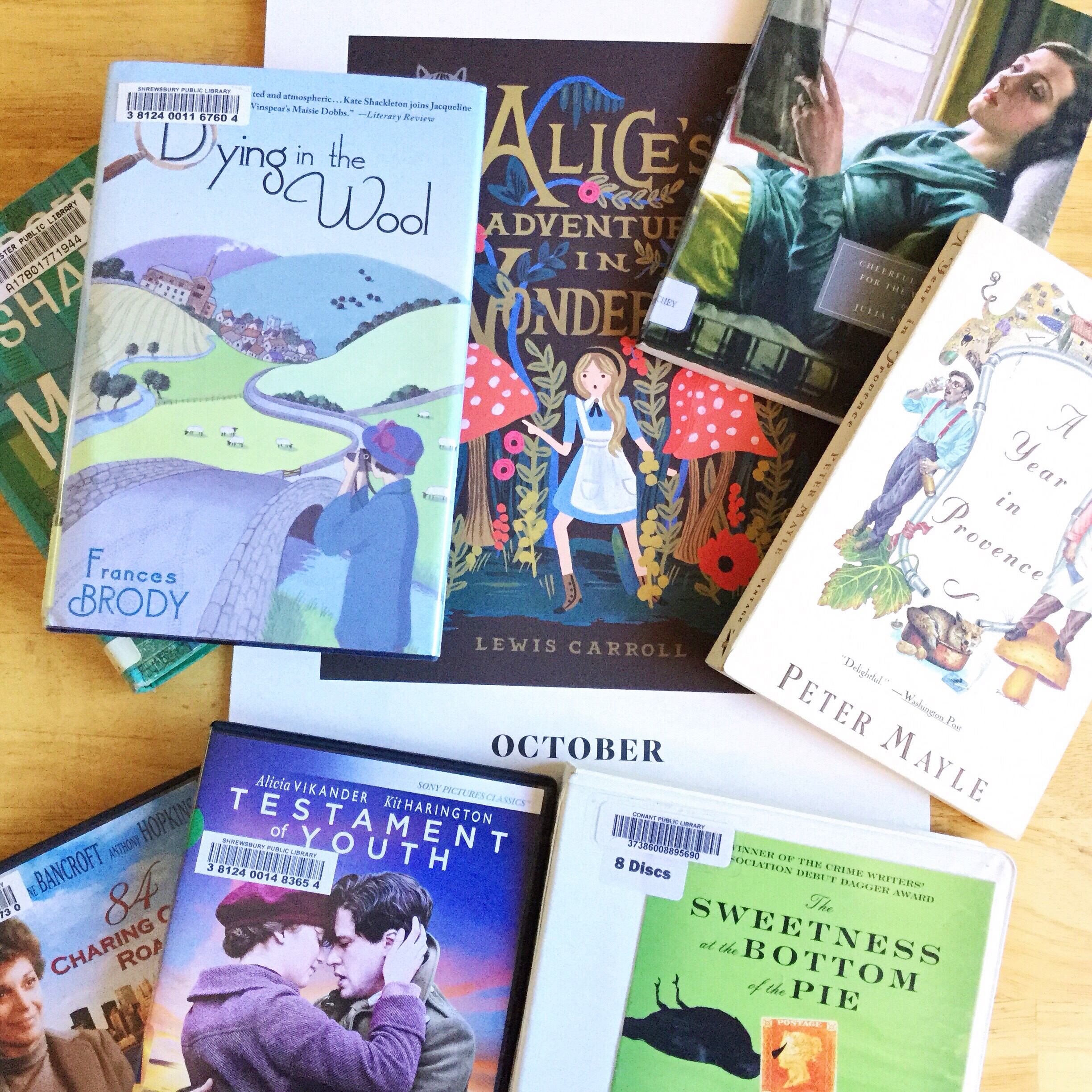
October 2015 Book Wrap Up

vscocam-photo-1
Here is a round up of bookish favourites for the month of October, 2015. For a glimpse into September, 2015’s Bookish Favourites look here.

1. Books

The month of October was a fine month for reading. After reading only two books in September I managed to read a grand total of nine books! Most of the books were superlative reads.

A Year in Provence (4/5*) by Peter Mayle describes the author’s year long diary style narrative of spending a year in a small village in Provence. The writing style is simple yet descriptive. A beautiful travelogue. I tried to read a chapter a month this year (corresponding to the month described in the book) but decided to finish the book off in October. For a look at my art journal entry based on the cover illustration look here.

The Eye of Love (4.5/5*) by Margery Sharp. This is an unusual, quirky, humorous fairytale romance story. An unlikely hero (portly, middle-aged Henry Gibson) and an unlikely heroine (angular, past her prime Dolores Diver) meet at a Chelsea Arts Ball dressed as a brown paper parcel and Spanish dancer respectively. Thus springs an unusual decade long love affair that is threatened by economic situations. Enter an unemotional orphaned niece with a large appetite for food and drawing random objects, a few unusual characters and situations, lots of candor, romance and intelligence and you have the makings of a fine novel. ‘The Eye of Love’ by Margery Sharp is a fantastic read. For a full review click here

A Murder is Announced (4/5*) by Agatha Christie. This is Christie at her best. A Murder is Announced is a Miss Marple story. In the small village of Chipping Cleghorn a murder is announced in the local gazette. The murder will take place at 6.30 pm on October 29th at Little Paddocks.Various neighbours and members of the household gather in the living room at the stipulated time. The lights go out at the exact time announced and a masked intruder charges into the room and orders everyone to stick their hands up. A gun shot is fired and when the lights turn on, the hooded guest is found dead on the floor. The motive behind the killing forms the core of the mystery. I enjoyed the structure of the story. Each chapter led us methodically, deeper and deeper into the mystery. Cozy, delicious details of village life in the Cotwolds interspersed the detecting. Miss Marple at her very best! A very enjoyable read.

84 Charing Cross Road (5/5*) by Helene Hanff. This is an account of the correspondence between Helene Hanff, a freelance writer in New York and Frank Doel, an employee of a used antiquarian bookstore in London. The correspondence is spread over the years 1949 to 1969, documenting the lively dialogue between two people, with nothing in common but a knowledge and love of good books. Set in the years after World War II, the reader is treated to an insight of the reality of what it was like to live in the aftermath of the war. The book is funny and poignant and shows how people separated by great distance and circumstances can nonetheless, touch each others lives and create the most beautiful of relationships.For a full review click here.

The Priory (5/5*) by Dorothy Whipple.

“She saw for the first time that the history of Saunby was a sad one. It had been diverted from its purpose; it had been narrowed from a great purpose to a little one. It had been built for the service of God and the people; all people, but especially the poor.”

‘The Priory’ is the story of how the future of Saunby Priory might be diverted to recover the livelihoods, dignity and self-worth of a large community of people, united in their purpose. It is a beautiful novel, worthy of the highest praise. For a full review click here

Inspector French’s Greatest Case (4/5*) by Freeman Wills Crofts. I reviewed Inspector French’s Greatest Case by Freeman Wills Crofts as part of  Simon from Stuck in a Book’s #The1924Club. In the second half of October everyone was asked to review books published in 1924. The link to the complete list of blogger reviews is here.
In ‘Inspector French’s Greatest Case’ we are introduced to a case of murder that occurs at the offices of Duke and Peabody, a diamond merchant located at Hatton Garden in London. On a cold night in the middle of November, the body of an employee, by the name of Mr. Charles Gething is discovered prostrate on the floor in the inner office of Mr. Duke. Mr. Duke’s large Milner safe has been ransacked with the loss of thirty-three thousand pounds worth of diamonds and a thousand pounds in bank notes. Mr. Gething has undoubtedly been murdered as evidenced from the ugly wound made to the back of the skull by a blunt instrument.
The theft of the diamonds and money previously secured in the safe are the motive behind the murder. To investigate the case, Inspector French of the Criminal Investigation Department of New Scotland Yard is called in. For a full review of the book click here.

Dying in the Wool by (3/5*) by Frances Brody. This a ‘cozy’ mystery set in post World War I Yorkshire. It is the first in the detective series starring an amateur sleuth- Kate Shackleton. In this case, Kate investigates the inexplicable disappearance of the father of an old friend of hers. The man in question, was a fabric mill owner. Though the characters in the story were well drawn and the details of the period depicted sounded authentic, the story failed to grip me.

Martha in Paris (4/5*) by Margery Sharp. This is the second book in the ‘Martha Trilogy’ of Margery Sharp , the first of which was ‘The Eye of Love’. In this book we find that the unusual character of Martha has grown up. She is eighteen and about to embark on an adventure. She is to stay in Paris for two whole years to study art. This short book is quirky and funny and made me laugh frequently. It also made me ponder about the trials and tribulations of falling in love with a person with an artistic temperament.

Cheerful Weather for the Wedding (5/5*) by Julia Strachey. This is the most unusual book I have read this year yet so very wonderful. This is a Persephone Classic. It describes at length the wedding day of a young girl who is reluctant to get married. The bride takes to glugging a bottle of Jamaica Rum in her bedroom to quell her fears whilst downstairs a strange collective of characters have assembled to participate in the wedding celebrations. There are eccentric relatives, friends, a former beau who wishes to propose and yet is not certain of himself and a bevy of peculiar servants who help in the wedding preparations. The book is interspersed with memorable dialogues. I highly recommend this book!

2. Blogposts

Most of the blogposts this month were book reviews. I published eight book reviews excluding this round-up post this month. Four were reviews of children’s books: Blueberries for Sal, Tuesday, Goodnight Moon and Owl Moon. The remaining four were reviews of ‘grown-up’ books- including The Eye of Love, Inspector French’s Greatest Case, 84 Charing Cross Road and The Priory.

3. Movies

Since I devoted most of my evening leisure time to reading I didn’t watch as many movies or TV series as usual. I did watch dramatizations of Miss Marple’s A Murder is Announced (starring Geraldine McEwan), 84 Charing Cross Road (I was not a fan of Anne Bancroft’s acting; I felt it was slightly too affected), a re-watch of Far From the Madding Crowd starring Carey Mulligan (the movie makes me want to re-read the book), Testament of Youth (re-watch) and Hocus Pocus on Halloween.

4. Audiobooks

 I started listening to Alan Bradley’s book ‘The Sweetness at the Bottom of the Pie’ on audio starring a young detective Flavia de Luce. This was fresh on the heels of completing the brilliant audio series ‘In and Out the Kitchen’ written by Miles Jupp.

5. Miscellaneous

 I bought a few books this month. These included a second hand book purchase of some beautiful books of the Emily of New Moon series by L.M. Montgomery. To take a look at the beautiful book covers click here. I also found two e-books from the British Library of Crime Classics series on sale – they are the Murder in Piccadilly by Charles Kingston and Resorting to Murder: Holiday Mysteries by Martin Edwards

6. Next Month

I am devoting the majority of next month’s books to reading Children’s Literature for #ReadKidsLit. I hope to discover/ rediscover the joy of childhood tales. Here is a peek at next month’s ‘TBR’ pile.

Wish you all a happy and bookish November!

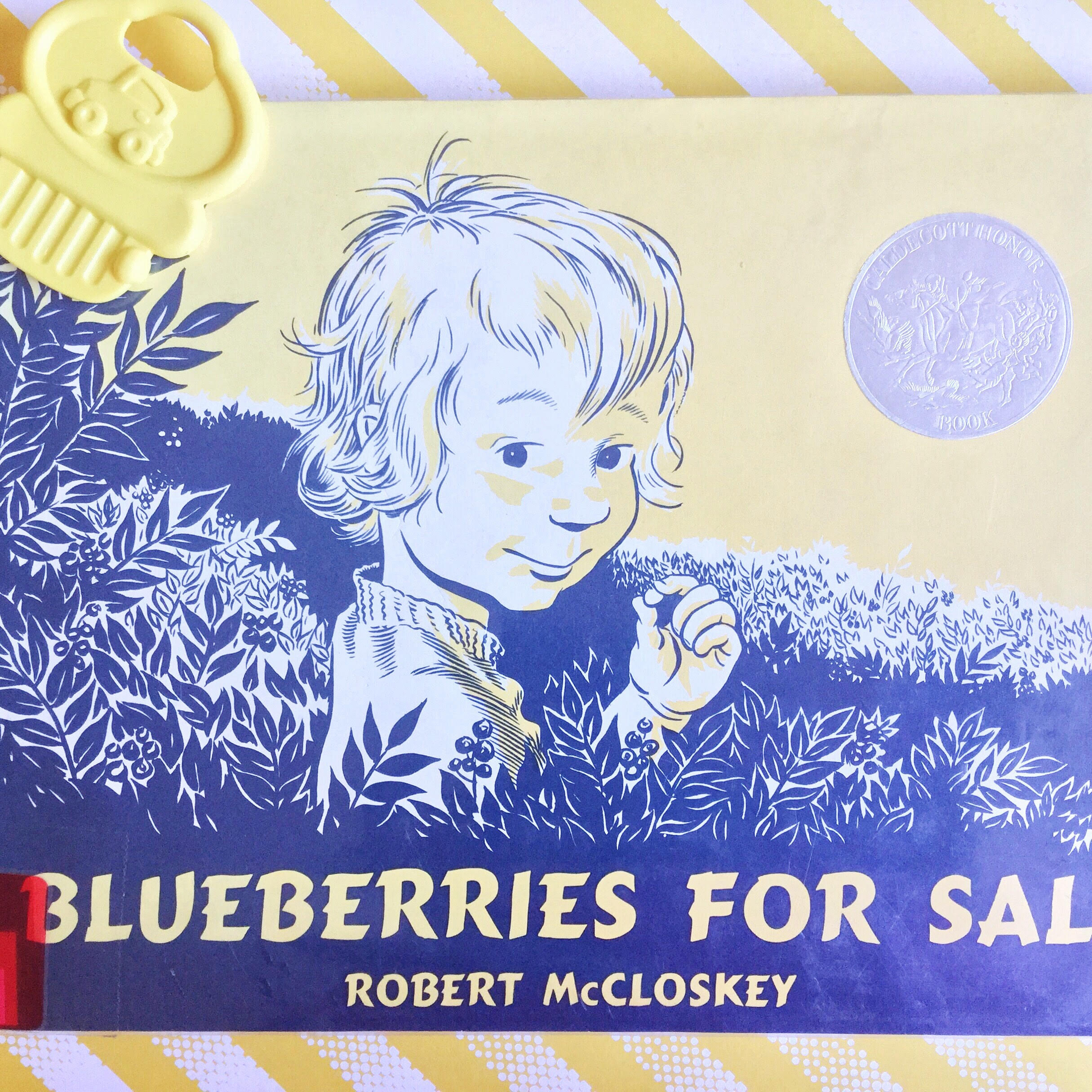
Blueberries for Sal by Robert McCloskey

unnamed

  • Title: Blueberries for Sal
  • Author and Illustrator: Robert McCloskey
  • Published: 1948
  • Main Characters: Sal (a very young child), her Mother, a mother Bear and her child Little Bear…

Short Synopsis of the Story: It is late summer and on Blueberry Hill the blueberry bushes are ripe for picking. Sal a young child and her mother laden with metal pails head over to Blueberry Hill to pick blueberries to can and preserve for the long winter ahead. Sal’s mother picks blueberries industriously but most of Sal’s blueberries make it into her mouth!

On the other side of Blueberry Hill a Mother Bear and her small cub are similarly employed in gathering blueberries. The Mother Bear wants to eat as many blueberries as she can before she and her cub hibernate for the long winter.

As luck would have it, Sal and her mother and the Mother Bear and her bear cub find themselves separated in their blueberry picking endeavours. Sal comes face to face with the Mother Bear who being very shy moves away from Sal. Similarly Sal’s Mother is caught unawares and finds herself face to face with the Little Bear.

Sal’s mother alarmedly rushes to search for Sal.

She hasn’t looked very far when she hears the familiar sound of blueberries plopping into an empty pail.

Little Bear’s mother has not searched very far before she hears a familiar hustling, munching and swallowing sound.

Little Bear and his mother and Little Sal and her mother are reunited and laden or filled with a great many blueberries they make their way home down opposite sides of Blueberry Hill.

Notes:  The favorite part of the story for me were the lovely line drawings of Robert McCloskey. The beautiful endpapers depicting a cozy kitchen scene where Sal and her Mother are busy canning blueberries are particularly charming. The story conveys the message that the animal instinct of storing food in scarcity is preserved across different species. The blubbery picking scenes are reminiscent of Maine where it seems McCloskey stayed. This is a gem of a book.

Particularly endearing are the descriptions of Sal plopping blueberries into her pail with a ‘kuplink, kuplank, kuplunk ‘ sound.

FullSizeRender

Inspector French’s Greatest Case by Freeman Wills Crofts

1924-Club

This review is for The 1924 Book Club. To discover more about this effort and to read additional reviews of books published in 1924 do visit Simon from Stuck in a Book’s hub post or Karen from Kaggsy’s Bookish Rambling’s hub page.

The first time I came across a reference to Freeman Wills Croft’s writing was when I was reading James Hilton’s classic story ‘Goodbye Mr. Chips’. I am always pleased to find bookish references within books and I read that Mr. Chips’s bottom bookshelf  was said to comprise of cheap editions of detective novels. His reading habits were thus described:

Sometimes he took down Vergil or Xenophon and read for a few moments, but he was soon back again with Doctor Thorndyke or Inspector French.

I had noted down Inspector French’s name for my ‘to be read’ list and thought no more of him until I was searching for a suitable book to review for The 1924 Book Club. ‘Inspector French’s Greatest Case’ was published in that year and to my delight I discovered this was the first entrée into the mystery series. Moreover, the book was available at my local library.

While I was researching alternative mystery story writers from this period I was surprised to find that the only writers of my acquaintance who were writing at that time were Agatha Christie and Dorothy L. Sayers. Agatha Christie published ‘The Man in the Brown Suit’ in the same year along with ‘Poirot Investigates’. Dorothy L. Sayers had published the first in her Lord Peter Wimsey crime series ‘Whose Body’ in 1923, after which there was a three year hiatus before ‘Clouds of Witness’ was published in 1926. In 1924 neither Margery Allingham (Crime at Black Dudley, 1929), Ngaio Marsh (A Man Lay Dead, 1934), Josephine Tey (The Man in the Queue, 1929)  or Edmund Crispin (Case of the Gilded Fly, 1944) had started publishing their work.

As a result of this discovery I went into reading this novel with the pre-conceived notion that the writing might be somewhat archaic. Nothing could be further from the truth. Freeman Wills Croft’s  writing is surprisingly modern, his language easy to read and his flow of thought fluent and comprehensible.

In ‘Inspector French’s Greatest Case‘ we are introduced to a case of murder that occurs at the offices of Duke and Peabody, a diamond merchant located at Hatton Garden in London. On a cold night in the middle of November, the body of an employee, by the name of Mr. Charles Gething is discovered prostrate on the floor in the inner office of Mr. Duke. Mr. Duke’s large Milner safe has been ransacked with the loss of thirty-three thousand pounds worth of diamonds and a thousand pounds in bank notes. Mr. Gething has undoubtedly been murdered as evidenced from the ugly wound made to the back of the skull by a blunt instrument.

The theft of the diamonds and money previously secured in the safe are the motive behind the murder. To investigate the case, Inspector French of the Criminal Investigation Department of New Scotland Yard is called in.

In our first introduction to Inspector French he is described as follows:

…The third was a stout man in tweeds, rather under middle height, with a clean shaven, good-humoured face and dark blue eyes, which, though keen, twinkled as if at some perennially fresh private joke. His air was easy-going and leisurely, and he looked the type of man who could enjoy a good dinner and a good smoke room story to follow.

Inspector French investigates the circumstantial evidence in a  methodical and systematic way. A paper trail led by the stolen bank notes leads him on a wild-goose chase across the beautiful Swiss Alps and later on to Barcelona and Amsterdam. There are a number of false clues and likely suspects. Inspector French leaves no stone unturned in his effort to grasp at the truth. He works tirelessly. We find that he becomes depressed when he has no immediate line of investigation to pursue.

It was only when he did not see his way clear that he became depressed and then he grew surly as a bear with a sore head, and his subordinates kept at as great a distance from him as their several activities would permit

Freeman Wills Crofts, the author of the novel worked as a railway engineer before turning to writing detective fiction. This background information surfaces in the plot line. There are many descriptions of train travel in the book. These train journeys and the places Inspector French passes on his travels through Europe are described in great detail and add an extra layer of appeal to the story. We travel with him to Interlaken, along the shores of the Lake of Thun, along the narrow gauge line that passes into the hearts of the giants of the Bernese Oberland; past the towering peaks of the Matterhorn, Eiger, the Mönch and the Jungfrau. The scenery unfolds in our imagination as we follow Wills Croft’s travelogue. Later we scramble across Channel crossing ferries at a moment’s notice along with French and travel the breath and depth of the continent to Havre, to Bordeaux by the Paris-Orleans line, then on the Midi to the Spanish frontier at Irun, and then via Medina and Salamanca to Oporto. Freeman Wills Croft’s fascination for train timetables is evident in the construction of the plot.

Wills Crofts builds up the story layer after layer in intricate detail. Multiple times the trail runs cold and much to French’s chagrin there is no immediate course of action . More than halfway into the story French observes:

It was a confoundedly exasperating case- just bristling with promising clues which one after another petered out as he came to follow them up

What do we learn about the personal nature of Inspector French? Has he the calculative obsessive temperament of a Poirot-like detective or does he share the amazing deductive powers of a genius like Sherlock Holmes? The answer is neither. Freeman Wills Croft’s detective Inspector French is the most ordinary of detectives, a hard-working humane person shunning cruel subversive techniques of interrogation in favour of a caring, kindly approach.

…He was not only a man of natural kindliness of heart, but he had the gift of imagination. He saw himself in the girl’s place; and was glad he had not added to her trouble.

Inspector French’s Greatest Case is not devoid of humour and charming domestic detail. Freeman Wills Croft describes an aspect of French’s home life that made me smile. Whenever Inspector French is perplexed with his case he returns home to his wife and describes in great detail aspects of the case that are troubling him. The poor lady, prevented from tacking the household chore she was engaged in is forced to take up her sewing and sit on the large Chesterfield armchair while French recounts the evidence.

Sometimes she interjected a remark, sometimes she didn’t; usually she warned him to be careful not to knock over the small table beside the piano, and invariably she wished he would walk on the less worn parts of the carpet

Usually Mrs. French ‘took a notion’ or asked unusual questions that shed light on the case in a different way.

We do not get to know very much more about Inspector French’s personal life in this book. We do learn that he has lost a son in the Great War but he appears to be intensely private about this tragedy.

Inspector French’s Greatest Case is a fantastic first novel in a series. I am curious to learn more about Inspector French, his dogged determination and his persistence.

Freeman Wills Crofts  has provided us with a refreshing ‘new detective’ (at least new to me). He delivers a carefully grafted, meticulously detailed plot. At every stage of the investigation we are privy to French’s thoughts and ideas so we do not feel cheated or left out. In the finale we are treated to a delightful twist in the plot which is done quite masterfully.

A big thank you to Simon for encouraging me to read a wonderful book from 1924.

The Priory by Dorothy Whipple

img_2027-2

Title: The Priory

Author: Dorothy Whipple

Published: 1939

Republished by Persephone Books

Setting: Rural Midlands in the Interwar Years

Main Characters: Major Marwood, Anthea Marwood (his second wife), Christine Marwood (elder daughter of Major Marwood), Penelope Marwood (younger daughter of Major Marwood), Nurse Pye, Aunt Victoria (spinster sister of Major Marwood), Mr. James Ashwell (wealthy former mill owner), Nicholas Ashwell (son of James Ashwell).

She saw for the first time that the history of Saunby was a sad one. It had been diverted from its purpose; it had been narrowed from a great purpose to a little one. It had been built for the service of God and the people; all people, but especially the poor.

‘And now it serves only us,’ she thought.

                                                                           – Christine Marwood.

In Dorothy Whipple’s novel, ‘The Priory’ , Saunby Priory is a large landed estate associated with the ruins of a medieval Priory. In olden times, pilgrims had sought rest here, on their way to Canterbury from the North. Kindly monks had allayed their hunger and tiredness with bread, beer and a place to sleep at night. After the Dissolution of the Monasteries during the Reformation the Priory passed on to the Perwyns and thereafter to the Marwood family in 1793.

The story commences a few years prior to the onset of the Second World War. The state of affairs of Major Marwood’s country estate, Saunby Priory, lies as dilapidated as the ancient ruins that lie on the western edge of the manor house. The Major is a widower, his two young daughters, Penelope and Christine, aged 19 and 20, run wild all day on his estate, his elderly sister Victoria is unable to guide his household affairs and he lies on the verge of financial ruin. Every year to save himself and Saunby he sells a small parcel of property associated with his estate. Then, at the august age of fifty, he meets Anthea Sumpton and recognizes in her a woman who to his mind has the ideal characteristics of a second wife, i.e. she is sensible, devoted and no longer young. Importantly, she will in all probability not want to start a family. He marries her so that someone at last will take his household to hand and manage his life: his servants, his children and his annual fortnight of summer cricket.

Anthea Marwood feels that she is an unwanted intruder in the Marwood household.

The occupants of Saunby looked at her when she came into a room as people in a railway carriage look at a traveller who gets in later on the journey. The Marwoods, she was beginning to find out, were the sort of people who like a carriage to themselves

Despite the initial setback Anthea faces, she quite slowly but steadily starts to carve a niche for herself in the household.

Quite early on in the marriage, Major Marwood realizes with dismay that his marriage of convenience is turning out to be very inconvenient for him. Anthea, contrary to plans is expecting a child, an added expense in his mountain of debts. Anthea, focuses all her attention in gathering provisions for her child and securing his/hers future.

In the meantime, in a whirlwind romance, Christine Marwood falls in love with Nicholas Ashwell, son of a wealthy former mill-owner when he visits Saunby during the cricketing fortnight. Their infatuation results in a marriage proposal that Christine accepts. Christine on the eve of her marriage is faced with the unwelcome prospect of leaving Saunby, a place that has been her sanctuary for the entirety of her life.

‘I don’t want to go’ thought Christine…

‘I want to stay here, as I am.’

Nicholas was a stranger. A few months ago she had never heard of him and now she was going away with him, throwing in her lot with his. What was love that it made you think you could live with a stranger? You ought to find out first, you ought to be sure.”

As Christine embarks on a new, unfamiliar life in the coastal seaside town of Mansbridge, she finds herself missing Saunby more and more. She realizes that married life with Nicholas is not enough to fill the gap left in her heart by her absence from Saunby. Her married life is far from idyllic- Nicholas’s idle lifestyle, gaming, drinking and frittering his life away makes her long for her former home more and more.

Whilst visiting Saunby during her sister Penelope’s wedding she is reluctant to go home to Mansbridge and her husband.

There were some black and yellow striped caterpillars that covered the tansy plants at Saunby…If you moved them to another plant they either died or made their way back to the tansy. Christine, noticing them again now, wondered if she was going to be like that about Saunby; unable to live anywhere else.

However, life decides to take a sharp turn for the worse for Christine and she finds herself separated from her husband, each of them fighting their own separate battles under heart wrenching circumstances. Can Saunby save their future, their feeling of self-worth and purpose in life?

It is difficult to summarize the scope of a large 500 page novel like ‘The Priory’ within the space of a few paragraphs. The book is so much more than the collective story of personal incidents, trials and tribulations of a household. Whilst reading the story it is hard to gauge the actual focus of the story. Is ‘The Priory’ the story of Anthea Marwood’s gradual adjustment to her new household, her determination to secure a stable future for her children, the story of Christine Marwood’s move to the Ashwell family at Mansbridge and her yearning for Saunby or is it the story of Nicholas Ashwell’s frustration in life for being nothing more than a rich man’s son incapable of finding his own way in life? ‘The Priory’ is the summation of all these stories and more. It deals us a sharp lesson in the fragility of good fortune in life.

At the heart of the story is the medieval Priory and the attached house at Saunby. Serving the purpose of just a roof over the heads of a single household it is a drain of individual resources and is too large and unruly to manage by a single person. Essentially, ‘The Priory’ is the story of how the future of Saunby Priory might be diverted to recover the livelihoods, dignity and self-worth of a large community of people, united in their purpose. It is a beautiful novel, worthy of the highest praise and Whipple is an author, whose writing I look forward to reading more of, in the near future.